|
5-1-1.
Preflight Preparation
a.
Every pilot is urged to receive a
preflight briefing and to file a flight plan. This
briefing should consist of the latest or most current
weather, airport, and en route NAVAID information.
Briefing service may be obtained from an FSS either by
telephone or interphone, by radio when airborne, or by
a personal visit to the station. Pilots with a current
medical certificate in the 48 contiguous States may
access toll-free the Direct User Access Terminal
System (DUATS) through a personal computer. DUATS will
provide alpha-numeric preflight weather data and allow
pilots to file domestic VFR or IFR flight plans.
REFERENCE-
AIM, FAA Weather Services, Paragraph 7-1-2, Lists
DUATS Vendors.
NOTE-
Pilots filing flight plans via "fast file" who desire
to have their briefing recorded, should include a
statement at the end of the recording as to the source
of their weather briefing.
b.
The information required by the FAA to
process flight plans is contained on FAA Form 7233-1,
Flight Plan. The forms are available at all flight
service stations. Additional copies will be provided
on request.
REFERENCE-
AIM, Flight Plan- VFR Flights, Paragraph 5-1-4.
AIM, Flight Plan- IFR Flights, Paragraph 5-1-7.
c.
Consult an FSS or a Weather Service
Office (WSO) for preflight weather briefing.
Supplemental Weather Service Locations (SWSL's) do not
provide weather briefings.
d.
FSS's are required to advise of
pertinent NOTAM's if a standard briefing is
requested, but if they are overlooked, don't hesitate
to remind the specialist that you have not received
NOTAM information.
NOTE-
NOTAM's which are known in sufficient time for
publication and are of 7 days duration or longer are
normally incorporated into the Notices to Airmen
Publication and carried there until cancellation time.
FDC NOTAM's, which apply to instrument flight
procedures, are also included in the Notices to Airmen
Publication up to and including the number indicated
in the FDC NOTAM legend. Printed NOTAM's are not
provided during a briefing unless specifically
requested by the pilot since the FSS specialist has no
way of knowing whether the pilot has already checked
the Notices to Airmen Publication prior to calling.
Remember to ask for NOTAM's in the Notices to Airmen
Publication. This information is not normally
furnished during your briefing.
REFERENCE-
AIM, Notice to Airmen (NOTAM) System, Paragraph 5-1-3.
e.
Pilots are urged to use only the latest
issue of aeronautical charts in planning and
conducting flight operations. Aeronautical charts are
revised and reissued on a regular scheduled basis to
ensure that depicted data are current and reliable. In
the conterminous U.S., Sectional Charts are updated
every 6 months, IFR En Route Charts every 56 days, and
amendments to civil IFR Approach Charts are
accomplished on a 56-day cycle with a change notice
volume issued on the 28-day midcycle. Charts that have
been superseded by those of a more recent date may
contain obsolete or incomplete flight information.
REFERENCE-
AIM, General Description of Each Chart Series,
Paragraph 9-1-4.
f.
When requesting a preflight briefing,
identify yourself as a pilot and provide the
following:
1. Type of flight
planned; e.g., VFR or IFR.
2. Aircraft's
number or pilot's name.
3. Aircraft type.
4. Departure
Airport.
5. Route of
flight.
6. Destination.
7. Flight
altitude(s).
8. ETD and ETE.
g.
Prior to conducting a briefing,
briefers are required to have the background
information listed above so that they may tailor the
briefing to the needs of the proposed flight. The
objective is to communicate a "picture" of
meteorological and aeronautical information necessary
for the conduct of a safe and efficient flight.
Briefers use all available weather and aeronautical
information to summarize data applicable to the
proposed flight. They do not read weather reports and
forecasts verbatim unless specifically requested by
the pilot.
REFERENCE-
AIM, Preflight Briefings, Paragraph 7-1-3, contains
those items of a weather briefing that should be
expected or requested.
h.
FAA by 14 CFR Part 93, Subpart K, has
designated High Density Traffic Airports (HDTA's) and
has prescribed air traffic rules and requirements for
operating aircraft (excluding helicopter operations)
to and from these airports.
REFERENCE-
Airport/Facility Directory, Special Notices Section.
AIM, Airport Reservations Operations and Procedures,
Paragraph 4-1-21.
i.
In addition to the filing of a flight
plan, if the flight will traverse or land in one or
more foreign countries, it is particularly important
that pilots leave a complete itinerary with someone
directly concerned and keep that person advised of the
flight's progress. If serious doubt arises as to the
safety of the flight, that person should first contact
the FSS.
REFERENCE-
AIM, Flights Outside the U.S. and U.S. Territories,
Paragraph 5-1-9.
j.
Pilots operating under provisions of 14
CFR Part 135 and not having an FAA assigned 3-letter
designator, are urged to prefix the normal
registration (N) number with the letter "T" on flight
plan filing; e.g., TN1234B.
REFERENCE-
AIM, Aircraft Call Signs, Paragraph 4-2-4.

5-1-2.
Follow IFR Procedures Even When Operating VFR
a.
To maintain IFR proficiency, pilots are
urged to practice IFR procedures whenever possible,
even when operating VFR. Some suggested practices
include:
1.
Obtain a complete preflight and
weather briefing. Check the NOTAM's.
2.
File a flight plan. This is an
excellent low cost insurance policy. The cost is the
time it takes to fill it out. The insurance includes
the knowledge that someone will be looking for you
if you become overdue at your destination.
3.
Use current charts.
4.
Use the navigation aids. Practice
maintaining a good course-keep the needle centered.
5.
Maintain a constant altitude which is
appropriate for the direction of flight.
6.
Estimate en route position times.
7.
Make accurate and frequent position
reports to the FSS's along your route of flight.
b.
Simulated IFR flight is recommended
(under the hood); however, pilots are cautioned to
review and adhere to the requirements specified in 14
CFR Section 91.109 before and during such flight.
c.
When flying VFR at night, in addition
to the altitude appropriate for the direction of
flight, pilots should maintain an altitude which is at
or above the minimum en route altitude as shown on
charts. This is especially true in mountainous
terrain, where there is usually very little ground
reference. Do not depend on your eyes alone to avoid
rising unlighted terrain, or even lighted obstructions
such as TV towers.
5-1-3. Notice
to Airmen (NOTAM) System
a.
Time-critical aeronautical information
which is of either a temporary nature or not
sufficiently known in advance to permit publication on
aeronautical charts or in other operational
publications receives immediate dissemination via the
National NOTAM System.
NOTE-
1. NOTAM
information is that aeronautical information that
could affect a pilot's decision to make a flight. It
includes such information as airport or primary runway
closures, changes in the status of navigational aids,
ILS's, radar service availability, and other
information essential to planned en route, terminal,
or landing operations.
2. NOTAM information is transmitted using
standard contractions to reduce transmission time. See
TBL 5-1-1 for a listing of the most commonly used
contractions.
b.
NOTAM information is classified into
three categories. These are NOTAM (D) or distant,
NOTAM (L) or local, and Flight Data Center (FDC)
NOTAM's.
1. NOTAM (D)
information is disseminated for all navigational
facilities that are part of the National Airspace
System (NAS), all public use airports, seaplane
bases, and heliports listed in the Airport/Facility
Directory (A/FD). The complete file of all NOTAM (D)
information is maintained in a computer database at
the Weather Message Switching Center (WMSC), located
in Atlanta, Georgia. This category of information is
distributed automatically via Service A
telecommunications system. Air traffic facilities,
primarily FSS's, with Service A capability have
access to the entire WMSC database of NOTAM's. These
NOTAM's remain available via Service A for the
duration of their validity or until published. Once
published, the NOTAM data is deleted from the
system.
2. NOTAM (L)
(a)
NOTAM (L) information includes such
data as taxiway closures, personnel and equipment
near or crossing runways, airport rotating beacon
outages and airport lighting aids that do not
affect instrument approach criteria, such as VASI.
(b)
NOTAM (L) information is
distributed locally only and is not attached to
the hourly weather reports. A separate file of
local NOTAM's is maintained at each FSS for
facilities in their area only. NOTAM (L)
information for other FSS areas must be
specifically requested directly from the FSS that
has responsibility for the airport concerned.
3. FDC NOTAM's
(a)
On those occasions when it becomes
necessary to disseminate information which is
regulatory in nature, the National Flight Data
Center (NFDC), in Washington, DC, will issue an
FDC NOTAM. FDC NOTAM's contain such things as
amendments to published IAP's and other current
aeronautical charts. They are also used to
advertise temporary flight restrictions caused by
such things as natural disasters or large-scale
public events that may generate a congestion of
air traffic over a site.
(b)
FDC NOTAM's are transmitted via
Service A only once and are kept on file at the
FSS until published or canceled. FSS's are
responsible for maintaining a file of current,
unpublished FDC NOTAM's concerning conditions
within 400 miles of their facilities. FDC
information concerning conditions that are more
than 400 miles from the FSS, or that is already
published, is given to a pilot only on request.
NOTE-
1. DUATS
vendors will provide FDC NOTAM's only upon
site-specific requests using a location
identifier.
2. NOTAM data may not always be
current due to the changeable nature of national
airspace system components, delays inherent in
processing information, and occasional temporary
outages of the U.S. NOTAM system. While en route,
pilots should contact FSS's and obtain updated
information for their route of flight and
destination.
c.
An integral part of the NOTAM System is
the Notices to Airmen Publication (NTAP) published
every four weeks. Data is included in this publication
to reduce congestion on the telecommunications
circuits and, therefore, is not available via Service
A. Once published, the information is not provided
during pilot weather briefings unless specifically
requested by the pilot. This publication contains two
sections.
1.
The first section consists of notices
that meet the criteria for NOTAM (D) and are
expected to remain in effect for an extended period
and FDC NOTAM's that are current at the time of
publication. Occasionally, some NOTAM (L) and other
unique information is included in this section when
it will contribute to flight safety.
2.
The second section contains special
notices that are either too long or concern a wide
or unspecified geographic area and are not suitable
for inclusion in the first section. The content of
these notices vary widely and there are no specific
criteria for their inclusion, other than their
enhancement of flight safety.
3.
The number of the last FDC NOTAM
included in the publication is noted on the first
page to aid the user in updating the listing with
any FDC NOTAM's which may have been issued between
the cut-off date and the date the publication is
received. All information contained will be carried
until the information expires, is canceled, or in
the case of permanent conditions, is published in
other publications, such as the A/FD.
4.
All new notices entered, excluding
FDC NOTAM's, will be published only if the
information is expected to remain in effect for at
least 7 days after the effective date of the
publication.
d.
NOTAM information is not available from
a Supplemental Weather Service Locations (SWSL).
TBL 5-1-1
NOTAM CONTRACTIONS
|
|
A
|
|
AADC |
Approach and
Departure Control |
|
ABV |
Above |
|
A/C |
Approach Control
|
|
ACCUM |
Accumulate
|
|
ACFT |
Aircraft
|
|
ACR |
Air Carrier
|
|
ACTV/ACTVT
|
Active/Activate
|
|
ADF |
Automatic Direction
Finder |
|
AFSS |
Automated Flight
Service Station |
|
ADJ |
Adjacent
|
|
ADZ/ADZD
|
Advise/Advised
|
|
AFD |
Airport/Facility
Directory |
|
ALS |
Approach Light
System |
|
ALTM |
Altimeter
|
|
ALTN/ALTNLY
|
Alternate/Alternately |
|
ALSTG |
Altimeter Setting
|
|
AMDT |
Amendment
|
|
APCH |
Approach
|
|
APL |
Airport Lights
|
|
ARFF |
Aircraft Rescue &
Fire Fighting |
|
ARPT |
Airport
|
|
ARSR |
Air Route
Surveillance Radar |
|
ASDE |
Airport Surface
Detection Equipment |
|
ASOS |
Automated Surface
Observing System |
|
ASPH |
Asphalt
|
|
ASR |
Airport
Surveillance Radar |
|
ATC |
Air Traffic Control
|
|
ATCT |
Airport Traffic
Control Tower |
|
ATIS |
Automated Terminal
Information Service |
|
AVBL |
Available
|
|
AWOS |
Automatic Weather
Observing System |
|
AZM |
Azimuth
|
|
|
B
|
|
BC |
Back Course
|
|
BCN |
Beacon |
|
BERM |
Snowbank/s
Containing Earth/Gravel |
|
BLO |
Below |
|
BND |
Bound |
|
BRAF |
Braking Action Fair
|
|
BRAG |
Braking Action Good
|
|
BRAN |
Braking Action Nil
|
|
BRAP |
Braking Action Poor
|
|
BYD |
Beyond |
|
|
C
|
|
CAAS |
Class A Airspace
|
|
CAT |
Category
|
|
CBAS |
Class B Airspace
|
|
CBSA |
Class B Surface
Area |
|
CCAS |
Class C Airspace
|
|
CCLKWS |
Counterclockwise
|
|
CCSA |
Class C Surface
Area |
|
CD |
Clearance Delivery
|
|
CDAS |
Class D Airspace
|
|
CDSA |
Class D Surface
Area |
|
CEAS |
Class E Airspace
|
|
CESA |
Class E Surface
Area |
|
CFA |
Controlled Firing
Area |
|
CGAS |
Class G Airspace
|
|
CHG |
Change |
|
CLKWS |
Clockwise
|
|
CLNC |
Clearance
|
|
CLSD |
Closed |
|
CMSN/CMSND
|
Commission/Commissioned |
|
CNCL/CNCLD/CNL
|
Cancel/Canceled/Cancel
|
|
CNTRLN |
Centerline
|
|
CONC |
Concrete
|
|
CONT |
Continue/Continuously |
|
CRS |
Course |
|
CTAF |
Common Traffic
Advisory Frequency |
|
CTLZ |
Control Zone
|
|
|
D
|
|
DALGT |
Daylight
|
|
DCMS/DCMSND
|
Decommission/Decommissioned |
|
DCT |
Direct |
|
DEP |
Depart/Departure
|
|
DEPT |
Department
|
|
DH |
Decision Height
|
|
DISABLD
|
Disabled
|
|
DLA/DLAD
|
Delay/Delayed
|
|
DLT/DLTD
|
Delete/Deleted
|
|
DLY |
Daily |
|
DME |
Distance Measuring
Equipment |
|
DMSTN |
Demonstration
|
|
DP |
Instrument
Departure Procedure |
|
DPCR |
Departure Procedure
|
|
DRCT |
Direct |
|
DRFT/DRFTD
|
Drift/Drifted
Snowbank/s Caused By Wind Action |
|
DSPLCD |
Displaced
|
|
DSTC |
Distance
|
|
DWPNT |
Dew Point
|
|
|
E
|
|
E |
East |
|
EBND |
Eastbound
|
|
EFAS |
En Route Flight
Advisory Service |
|
EFF |
Effective
|
|
ELEV |
Elevate/Elevation
|
|
ENG |
Engine |
|
ENTR |
Entire |
|
EXCP |
Except |
|
|
F
|
|
FA |
Final Approach
|
|
FAC |
Facility
|
|
FAF |
Final Approach Fix
|
|
FDC |
Flight Data Center
|
|
FM |
Fan Marker
|
|
FREQ |
Frequency
|
|
FRH |
Fly Runway Heading
|
|
FRZN |
Frozen |
|
FRNZ SLR
|
Frozen Slush on
Runway/s |
|
FSS |
Flight Service
Station |
|
|
G
|
|
GC |
Ground Control
|
|
GCA |
Ground Controlled
Approach |
|
GOVT |
Government
|
|
GP |
Glide Path
|
|
GPS |
Global Positioning
System |
|
GRVL |
Gravel |
|
GS |
Glide Slope
|
|
|
H
|
|
HAA |
Height Above
Airport |
|
HAT |
Height Above
Touchdown |
|
HAZ |
Hazard |
|
HEL |
Helicopter
|
|
HELI |
Heliport
|
|
HF |
High Frequency
|
|
HIRL |
High Intensity
Runway Lights |
|
HIWAS |
Hazardous Inflight
Weather Advisory Service |
|
HOL |
Holiday
|
|
HP |
Holding Pattern
|
|
|
I
|
|
IAP |
Instrument Approach
Procedure |
|
IBND |
Inbound
|
|
ID |
Identification
|
|
IDENT |
Identify/Identifier/Identification |
|
IFR |
Instrument Flight
Rules |
|
ILS |
Instrument Landing
System |
|
IM |
Inner Marker
|
|
IN |
Inch/Inches
|
|
INDEFLY
|
Indefinitely
|
|
INOP |
Inoperative
|
|
INST |
Instrument
|
|
INT |
Intersection
|
|
INTST |
Intensity
|
|
IR |
Ice On Runway/s
|
|
|
L
|
|
L |
Left |
|
LAA |
Local Airport
Advisory |
|
LAT |
Latitude
|
|
LAWRS |
Limited Aviation
Weather Reporting Station |
|
LB |
Pound/Pounds
|
|
LC |
Local Control
|
|
LCL |
Local |
|
LCTD |
Located
|
|
LDA |
Localizer Type
Directional Aid |
|
LDIN |
Lead In Lighting
System |
|
LGT/LGTD/LGTS
|
Light/Lighted/Lights |
|
LIRL |
Low Intensity
Runway Edge Lights |
|
LLWAS |
Low Level Wind
Shear Alert System |
|
LMM |
Compass Locator at
ILS Middle Marker |
|
LNDG |
Landing
|
|
LOC |
Localizer
|
|
LOM |
Compass Locator at
ILS Outer Marker |
|
LONG |
Longitude
|
|
LRN |
LORAN |
|
LSR |
Loose Snow on
Runway/s |
|
LT |
Left Turn After
Take-off |
|
|
M
|
|
MALS |
Medium Intensity
Approach Lighting System |
|
MALSF |
Medium Intensity
Approach Lighting System with Sequenced Flashers
|
|
MALSR |
Medium Intensity
Approach Lighting System with Runway Alignment
Indicator Lights |
|
MAP |
Missed Approach
Point |
|
MCA |
Minimum Crossing
Altitude |
|
MDA |
Minimum Descent
Altitude |
|
MEA |
Minimum En Route
Altitude |
|
MED |
Medium |
|
MIN |
Minute |
|
MIRL |
Medium Intensity
Runway Edge Lights |
|
MLS |
Microwave Landing
System |
|
MM |
Middle Marker
|
|
MNM |
Minimum
|
|
MOCA |
Minimum Obstruction
Clearance Altitude |
|
MONTR |
Monitor
|
|
MSA |
Minimum Safe
Altitude/Minimum Sector Altitude |
|
MSAW |
Minimum Safe
Altitude Warning |
|
MSL |
Mean Sea Level
|
|
MU |
Designate a
Friction Value Representing Runway Surface
Conditions |
|
MUD |
Mud |
|
MUNI |
Municipal
|
|
|
N
|
|
N |
North |
|
NA |
Not Authorized
|
|
NBND |
Northbound
|
|
NDB |
Nondirectional
Radio Beacon |
|
NE |
Northeast
|
|
NGT |
Night |
|
NM |
Nautical Mile/s
|
|
NMR |
Nautical Mile
Radius |
|
NOPT |
No Procedure Turn
Required |
|
NTAP |
Notice To Airmen
Publication |
|
NW |
Northwest
|
|
|
O
|
|
OBSC |
Obscured
|
|
OBSTN |
Obstruction
|
|
OM |
Outer Marker
|
|
OPER |
Operate
|
|
OPN |
Operation
|
|
ORIG |
Original
|
|
OTS |
Out of Service
|
|
OVR |
Over |
|
|
P
|
|
PAEW |
Personnel and
Equipment Working |
|
PAJA |
Parachute Jumping
Activities |
|
PAPI |
Precision Approach
Path Indicator |
|
PAR |
Precision Approach
Radar |
|
PARL |
Parallel
|
|
PAT |
Pattern
|
|
PCL |
Pilot Controlled
Lighting |
|
PERM/PERMLY
|
Permanent/Permanently |
|
PLA |
Practice Low
Approach |
|
PLW |
Plow/Plowed
|
|
PN |
Prior Notice
Required |
|
PPR |
Prior Permission
Required |
|
PREV |
Previous
|
|
PRIRA |
Primary Radar
|
|
PROC |
Procedure
|
|
PROP |
Propeller
|
|
PSGR |
Passenger/s
|
|
PSR |
Packed Snow on
Runway/s |
|
PT/PTN |
Procedure Turn
|
|
PVT |
Private
|
|
|
R
|
|
RAIL |
Runway Alignment
Indicator Lights |
|
RCAG |
Remote
Communication Air/Ground Facility |
|
RCL |
Runway Centerline
|
|
RCLS |
Runway Centerline
Light System |
|
RCO |
Remote
Communication Outlet |
|
RCV/RCVR
|
Receive/Receiver
|
|
REF |
Reference
|
|
REIL |
Runway End
Identifier Lights |
|
RELCTD |
Relocated
|
|
RMDR |
Remainder
|
|
RNAV |
Area Navigation
|
|
RPRT |
Report |
|
RQRD |
Required
|
|
RRL |
Runway Remaining
Lights |
|
RSVN |
Reservation
|
|
RT |
Right Turn after
Take-off |
|
RTE |
Route |
|
RTR |
Remote
Transmitter/Receiver |
|
RTS |
Return to Service
|
|
RUF |
Rough |
|
RVR |
Runway Visual Range
|
|
RVRM |
RVR Midpoint
|
|
RVRR |
RVR Rollout
|
|
RVRT |
RVR Touchdown
|
|
RVV |
Runway Visibility
Value |
|
RY/RWY |
Runway |
|
|
S
|
|
S |
South |
|
SBND |
Southbound
|
|
SDF |
Simplified
Directional Facility |
|
SE |
Southeast
|
|
SECRA |
Secondary Radar
|
|
SFL |
Sequenced Flashing
Lights |
|
SI |
Straight-In
Approach |
|
SIR |
Packed or Compacted
Snow and Ice on Runway/s |
|
SKED |
Scheduled
|
|
SLR |
Slush on Runway/s
|
|
SNBNK |
Snowbank/s Caused
by Plowing |
|
SND |
Sand/Sanded
|
|
SNGL |
Single |
|
SNW |
Snow |
|
SPD |
Speed |
|
SR |
Sunrise
|
|
SS |
Sunset |
|
SSALF |
Simplified Short
Approach Lighting System with Sequenced Flashers
|
|
SSALR |
Simplified Short
Approach Lighting System with Runway Alignment
Indicator Lights |
|
SSALS |
Simplified Short
Approach Lighting System |
|
STAR |
Standard Terminal
Arrival |
|
SVC |
Service
|
|
SW |
Southwest
|
|
SWEPT |
Swept or Broom/Broomed
|
|
|
T
|
|
TACAN |
Tactical Air
Navigational Aid |
|
TDZ/TDZL
|
Touchdown
Zone/Touchdown Zone Lights |
|
TFC |
Traffic
|
|
TFR |
Temporary Flight
Restriction |
|
TGL |
Touch and Go
Landings |
|
THN |
Thin |
|
THR |
Threshold
|
|
THRU |
Through
|
|
TIL |
Until |
|
TKOF |
Takeoff
|
|
TMPRY |
Temporary
|
|
TRML |
Terminal
|
|
TRNG |
Training
|
|
TRSA |
Terminal Radar
Service Area |
|
TRSN |
Transition
|
|
TSNT |
Transient
|
|
TWEB |
Transcribed Weather
Broadcast |
|
TWR |
Tower |
|
TWY |
Taxiway
|
|
|
U
|
|
UNAVBL |
Unavailable
|
|
UNLGTD |
Unlighted
|
|
UNMKD |
Unmarked
|
|
UNMON |
Unmonitored
|
|
UNRELBL
|
Unreliable
|
|
UNUSBL |
Unusable
|
|
|
V
|
|
VASI |
Visual Approach
Slope Indicator |
|
VDP |
Visual Descent
Point |
|
VFR |
Visual Flight Rules
|
|
VIA |
By Way Of
|
|
VICE |
Instead/Versus
|
|
VIS/VSBY
|
Visibility
|
|
VMC |
Visual
Meteorological Conditions |
|
VOL |
Volume |
|
VOLMET |
Meteorlogical
Information for Aircraft in Flight |
|
VOR |
VHF
Omni-Directional Radio Range |
|
VORTAC |
VOR and TACAN
(collocated) |
|
VOT |
VOR Test Signal
|
|
|
W
|
|
W |
West |
|
WBND |
Westbound
|
|
WEA/WX |
Weather
|
|
WI |
Within |
|
WKDAYS |
Monday through
Friday |
|
WKEND |
Saturday and Sunday
|
|
WND |
Wind |
|
WP |
Waypoint
|
|
WSR |
Wet Snow on
Runway/s |
|
WTR |
Water on Runway/s
|
|
WX |
Weather
|
|
/ |
And |
|
+ |
In Addition/Also
|
5-1-4. Flight Plan -
VFR Flights
a.
Except for operations in or penetrating
a Coastal or Domestic ADIZ or DEWIZ a flight plan is
not required for VFR flight.
REFERENCE-
AIM, National Security, Paragraph 5-6-1.
b.
It is strongly recommended that a
flight plan (for a VFR flight) be filed with an FAA
FSS. This will ensure that you receive VFR Search and
Rescue Protection.
REFERENCE-
AIM, Search and Rescue, Paragraph 6-2-7 gives the
proper method of filing a VFR flight plan.
c.
To obtain maximum benefits from the
flight plan program, flight plans should be filed
directly with the nearest FSS. For your convenience,
FSS's provide aeronautical and meteorological
briefings while accepting flight plans. Radio may be
used to file if no other means are available.
NOTE-
Some states operate aeronautical communications
facilities which will accept and forward flight plans
to the FSS for further handling.
d.
When a "stopover" flight is
anticipated, it is recommended that a separate flight
plan be filed for each "leg" when the stop is expected
to be more than 1 hour duration.
e.
Pilots are encouraged to give their
departure times directly to the FSS serving the
departure airport or as otherwise indicated by the FSS
when the flight plan is filed. This will ensure more
efficient flight plan service and permit the FSS to
advise you of significant changes in aeronautical
facilities or meteorological conditions. When a VFR
flight plan is filed, it will be held by the FSS until
1 hour after the proposed departure time unless:
1.
The actual departure time is
received.
2.
A revised proposed departure time is
received.
3.
At a time of filing, the FSS is
informed that the proposed departure time will be
met, but actual time cannot be given because of
inadequate communications (assumed departures).
f.
On pilot's request, at a location
having an active tower, the aircraft identification
will be forwarded by the tower to the FSS for
reporting the actual departure time. This procedure
should be avoided at busy airports.
g.
Although position reports are not
required for VFR flight plans, periodic reports to FAA
FSS's along the route are good practice. Such contacts
permit significant information to be passed to the
transiting aircraft and also serve to check the
progress of the flight should it be necessary for any
reason to locate the aircraft.
EXAMPLE-
1. Bonanza 314K,
over Kingfisher at (time), VFR flight plan, Tulsa to
Amarillo.
2. Cherokee 5133J, over Oklahoma City at
(time), Shreveport to Denver, no flight plan.
h.
Pilots not operating on an IFR flight
plan and when in level cruising flight, are cautioned
to conform with VFR cruising altitudes appropriate to
the direction of flight.
i.
When filing VFR flight plans, indicate
aircraft equipment capabilities by appending the
appropriate suffix to aircraft type in the same manner
as that prescribed for IFR flight.
REFERENCE-
AIM, Flight Plan- IFR Flights, Paragraph 5-1-7.
j.
Under some circumstances, ATC computer
tapes can be useful in constructing the radar history
of a downed or crashed aircraft. In each case,
knowledge of the aircraft's transponder equipment is
necessary in determining whether or not such computer
tapes might prove effective.
k.
Flight Plan Form - (See FIG 5-1-1).
FIG 5-1-1
FAA Flight Plan
Form 7233-1 (8-82)
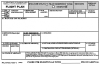
l. Explanation of
VFR Flight Plan Items.
1. Block 1.
Check the type flight plan. Check
both the VFR and IFR blocks if composite VFR/IFR.
2. Block 2.
Enter your complete aircraft
identification including the prefix "N" if
applicable.
3. Block 3.
Enter the designator for the
aircraft, or if unknown, consult an FSS briefer.
4. Block 4.
Enter your true airspeed (TAS).
5. Block 5.
Enter the departure airport
identifier code, or if unknown, the name of the
airport.
6. Block 6.
Enter the proposed departure time
in Coordinated Universal Time (UTC) (Z). If
airborne, specify the actual or proposed departure
time as appropriate.
7. Block 7.
Enter the appropriate VFR
altitude (to assist the briefer in providing weather
and wind information).
8. Block 8.
Define the route of flight by
using NAVAID identifier codes and airways.
9. Block 9.
Enter the destination airport
identifier code, or if unknown, the airport name.
NOTE-
Include the city name (or even the state name) if
needed for clarity.
10. Block 10.
Enter your estimated time
en route in hours and minutes.
11. Block 11.
Enter only those remarks
pertinent to ATC or to the clarification of other
flight plan information, such as the appropriate
radiotelephony (call sign) associated with the
designator filed in Block 2. Items of a personal
nature are not accepted.
12. Block 12.
Specify the fuel on board
in hours and minutes.
13. Block 13.
Specify an alternate
airport if desired.
14. Block 14.
Enter your complete name,
address, and telephone number. Enter sufficient
information to identify home base, airport, or
operator.
NOTE-
This information is essential in the event of search
and rescue operations.
15. Block 15.
Enter total number of
persons on board (POB) including crew.
16. Block 16.
Enter the predominant
colors.
17. Block 17.
Record the FSS name for
closing the flight plan. If the flight plan is
closed with a different FSS or facility, state the
recorded FSS name that would normally have closed
your flight plan.
NOTE-
1. Optional-
record a destination telephone number to assist
search and rescue contact should you fail to report
or cancel your flight plan within 1/2 hour after
your estimated time of arrival (ETA).
2. The information transmitted to the
destination FSS will consist only of flight plan
blocks 2, 3, 9, and 10. Estimated time en route (ETE)
will be converted to the correct ETA.
5-1-5.
Flight Plan- Defense VFR (DVFR) Flights
VFR flights into a
Coastal or Domestic ADIZ/DEWIZ are required to file DVFR
flight plans for security purposes. Detailed ADIZ
procedures are found in Section 6, National Security and
Interception Procedures, of this chapter. (See 14 CFR
Part 99.)
5-1-6.
Composite Flight Plan (VFR/IFR Flights)
a.
Flight plans which specify VFR
operation for one portion of a flight, and IFR for
another portion, will be accepted by the FSS at the
point of departure. If VFR flight is conducted for the
first portion of the flight, pilots should report
their departure time to the FSS with whom the VFR/IFR
flight plan was filed; and, subsequently, close the
VFR portion and request ATC clearance from the FSS
nearest the point at which change from VFR to IFR is
proposed. Regardless of the type facility you are
communicating with (FSS, center, or tower), it is the
pilot's responsibility to request that facility to
"CLOSE VFR FLIGHT PLAN." The pilot must remain in VFR
weather conditions until operating in accordance with
the IFR clearance.
b.
When a flight plan indicates IFR for
the first portion of flight and VFR for the latter
portion, the pilot will normally be cleared to the
point at which the change is proposed. After reporting
over the clearance limit and not desiring further IFR
clearance, the pilot should advise ATC to cancel the
IFR portion of the flight plan. Then, the pilot should
contact the nearest FSS to activate the VFR portion of
the flight plan. If the pilot desires to continue the
IFR flight plan beyond the clearance limit, the pilot
should contact ATC at least 5 minutes prior to the
clearance limit and request further IFR clearance. If
the requested clearance is not received prior to
reaching the clearance limit fix, the pilot will be
expected to enter into a standard holding pattern on
the radial or course to the fix unless a holding
pattern for the clearance limit fix is depicted on a
U.S. Government or commercially produced (meeting FAA
requirements) low or high altitude enroute, area or
STAR chart. In this case the pilot will hold according
to the depicted pattern.
5-1-7. Flight
Plan- IFR Flights
a. General
1.
Prior to departure from within, or
prior to entering controlled airspace, a pilot must
submit a complete flight plan and receive an air
traffic clearance, if weather conditions are below
VFR minimums. Instrument flight plans may be
submitted to the nearest FSS or ATCT either in
person or by telephone (or by radio if no other
means are available). Pilots should file IFR flight
plans at least 30 minutes prior to estimated time of
departure to preclude possible delay in receiving a
departure clearance from ATC. In order to provide
FAA traffic management units strategic route
planning capabilities, nonscheduled operators
conducting IFR operations above FL 230 are requested
to voluntarily file IFR flight plans at least 4
hours prior to estimated time of departure (ETD). To
minimize your delay in entering Class B, Class C,
Class D, and Class E surface areas at destination
when IFR weather conditions exist or are forecast at
that airport, an IFR flight plan should be filed
before departure. Otherwise, a 30 minute delay is
not unusual in receiving an ATC clearance because of
time spent in processing flight plan data. Traffic
saturation frequently prevents control personnel
from accepting flight plans by radio. In such cases,
the pilot is advised to contact the nearest FSS for
the purpose of filing the flight plan.
NOTE-
There are several methods of obtaining IFR
clearances at nontower, non-FSS, and outlying
airports. The procedure may vary due to geographical
features, weather conditions, and the complexity of
the ATC system. To determine the most effective
means of receiving an IFR clearance, pilots should
ask the nearest FSS the most appropriate means of
obtaining the IFR clearance.
2.
When filing an IFR flight plan for a
Traffic Alert and Collision Avoidance System (TCAS)/
heavy equipped aircraft, add the prefix T for TCAS,
H for heavy, or B for both TCAS and heavy to the
aircraft type.
EXAMPLE-
T/B727/A
H/DC10/U
B/B747/R
3.
When filing an IFR flight plan for
flight in an aircraft equipped with a radar beacon
transponder, DME equipment, TACAN-only equipment,
Global Navigation Satellite System (GNSS), or a
combination of any of these types of equipment,
identify the equipment capability by adding a
suffix, preceded by a slant, to the AIRCRAFT TYPE,
as shown in
TBL 5-1-2.
4.
It is recommended that pilots file
the maximum transponder or navigation capability of
their aircraft in the equipment suffix. This will
provide ATC with the necessary information to
utilize all facets of navigational equipment and
transponder capabilities available.
NOTE-
The suffix is not to be added to the aircraft
identification or be transmitted by radio as part of
the aircraft identification.
b. Airways and Jet
Routes Depiction on Flight Plan
1.
It is vitally important that the
route of flight be accurately and completely
described in the flight plan. To simplify definition
of the proposed route, and to facilitate ATC, pilots
are requested to file via airways or jet routes
established for use at the altitude or flight level
planned.
2.
If flight is to be conducted via
designated airways or jet routes, describe the route
by indicating the type and number designators of the
airway(s) or jet route(s) requested. If more than
one airway or jet route is to be used, clearly
indicate points of transition. If the transition is
made at an unnamed intersection, show the next
succeeding NAVAID or named intersection on the
intended route and the complete route from that
point. Reporting points may be identified by using
authorized name/code as depicted on appropriate
aeronautical charts. The following two examples
illustrate the need to specify the transition point
when two routes share more than one transition fix.
EXAMPLE-
1. ALB J37 BUMPY
J14 BHM
Spelled out: from Albany, New York, via Jet Route 37
transitioning to Jet Route 14 at BUMPY intersection,
thence via Jet Route 14 to Birmingham, Alabama.
2. ALB J37 ENO J14 BHM
Spelled out: from Albany, New York, via Jet Route 37
transitioning to Jet Route 14 at Kenton VORTAC (ENO)
thence via Jet Route 14 to Birmingham, Alabama.
3.
The route of flight may also be
described by naming the reporting points or NAVAID's
over which the flight will pass, provided the points
named are established for use at the altitude or
flight level planned.
EXAMPLE-
BWI V44 SWANN V433 DQO
Spelled out: from Baltimore-Washington
International, via Victor 44 to Swann intersection,
transitioning to Victor 433 at Swann, thence via
Victor 433 to Dupont.
4.
When the route of flight is defined
by named reporting points, whether alone or in
combination with airways or jet routes, and the
navigational aids (VOR, VORTAC, TACAN, NDB) to be
used for the flight are a combination of different
types of aids, enough information should be included
to clearly indicate the route requested.
EXAMPLE-
LAX J5 LKV J3 GEG YXC FL 330 J500 VLR J515 YWG
Spelled out: from Los Angeles International via Jet
Route 5 Lakeview, Jet Route 3 Spokane, direct
Cranbrook, British Columbia VOR/DME, Flight Level
330 Jet Route 500 to Langruth, Manitoba VORTAC, Jet
Route 515 to Winnepeg, Manitoba.
5.
When filing IFR, it is to the pilot's
advantage to file a preferred route.
REFERENCE-
Preferred IFR Routes are described and tabulated in
the Airport/Facility Directory.
TBL 5-1-2
Aircraft Equipment
Suffixes
|
Suffix
|
Aircraft
Equipment Suffixes |
|
|
NO DME
|
|
/X |
No transponder
|
|
/T |
Transponder with no
Mode C |
|
/U |
Transponder with
Mode C |
|
|
DME
|
|
/D |
No transponder
|
|
/B |
Transponder with no
Mode C |
|
/A |
Transponder with
Mode C |
|
|
TACAN ONLY
|
|
/M |
No transponder
|
|
/N |
Transponder with no
Mode C |
|
/P |
Transponder with
Mode C |
|
|
AREA NAVIGATION
(RNAV) |
|
/Y |
LORAN, VOR/DME, or
INS with no transponder |
|
/C |
LORAN, VOR/DME, or
INS, transponder with no Mode C |
|
/I |
LORAN, VOR/DME, or
INS, transponder with Mode C |
|
|
ADVANCED RNAV
WITH TRANSPONDER AND MODE C (If an aircraft is
unable to operate with a transponder and/or Mode
C, it will revert to the appropriate code listed
above under Area Navigation.) |
|
/E |
Flight Management
System (FMS) with en route, terminal, and approach
capability. Equipment requirements are:
(a) Dual FMS which meets the specifications of AC
25-15, Approval of Flight Management Systems in
Transport Category Airplanes; AC 20-129,
Airworthiness Approval of Vertical Navigation (VNAV)
Systems for use in the U.S. NAS and Alaska; AC
20-130A, Airworthiness Approval of Navigation or
Flight Management Systems Integrating Multiple
Navigation Sensors; or equivalent criteria as
approved by Flight Standards.
(b) A flight director and autopilot control system
capable of following the lateral and vertical FMS
flight path.
(c) At least dual inertial reference units (IRU's).
(d) A database containing the waypoints and
speed/altitude constraints for the route and/or
procedure to be flown that is automatically loaded
into the FMS flight plan.
(e) An electronic map.
(U.S. and U.S. territories only unless otherwise
authorized.) |
|
/F |
A single FMS with
en route, terminal, and approach capability that
meets the equipment requirements of /E, (a)
through (d), above.
(U.S. and U.S. territories only unless otherwise
authorized.) |
|
/G |
Global Positioning
System (GPS)/Global Navigation Satellite System (GNSS)
equipped aircraft with en route and terminal
capability |
|
/R |
Required
Navigational Performance (Denotes capability to
operate in RNP designated airspace and routes)
|
|
/W |
Reduced Vertical
Separation Minima (RVSM) |
|
/Q |
Required Navigation
Performance (RNP) and Reduced Vertical Separation
Minima (RVSM) (Indicate approval for application
of RNP and RVSM separation standards.) It should
be noted that /Q is for automation purposes only
and will not be filed by system users. FAA
processors will convert the combination of /R+/W
to =/Q. |
6.
ATC may issue a DP or a STAR, as
appropriate.
REFERENCE-
AIM, Instrument Departures, Paragraph 5-2-6.
AIM, Standard Terminal Arrival (STAR), Flight
Management System Procedures (FMSP) for Arrivals,
Paragraph 5-4-1.
NOTE-
Pilots not desiring a DP or STAR should so indicate
in the remarks section of the flight plan as "no DP"
or "no STAR."
c. Direct Flights
1.
All or any portions of the route
which will not be flown on the radials or courses of
established airways or routes, such as direct route
flights, must be defined by indicating the radio
fixes over which the flight will pass. Fixes
selected to define the route shall be those over
which the position of the aircraft can be accurately
determined. Such fixes automatically become
compulsory reporting points for the flight, unless
advised otherwise by ATC. Only those navigational
aids established for use in a particular structure;
i.e., in the low or high structures, may be used to
define the en route phase of a direct flight within
that altitude structure.
2.
The azimuth feature of VOR aids and
that azimuth and distance (DME) features of VORTAC
and TACAN aids are assigned certain frequency
protected areas of airspace which are intended for
application to established airway and route use, and
to provide guidance for planning flights outside of
established airways or routes. These areas of
airspace are expressed in terms of cylindrical
service volumes of specified dimensions called
"class limits" or "categories."
REFERENCE-
AIM, Navigational Aid (NAVAID) Service Volumes,
Paragraph 1-1-8.
3.
An operational service volume has
been established for each class in which adequate
signal coverage and frequency protection can be
assured. To facilitate use of VOR, VORTAC, or TACAN
aids, consistent with their operational service
volume limits, pilot use of such aids for defining a
direct route of flight in controlled airspace should
not exceed the following:
(a)
Operations above FL 450 - Use aids
not more than 200 NM apart. These aids are
depicted on enroute high altitude charts.
(b)
Operation off established routes
from 18,000 feet MSL to FL 450 - Use aids not more
than 260 NM apart. These aids are depicted on
enroute high altitude charts.
(c)
Operation off established airways
below 18,000 feet MSL - Use aids not more than 80
NM apart. These aids are depicted on enroute low
altitude charts.
(d)
Operation off established airways
between 14,500 feet MSL and 17,999 feet MSL in the
conterminous U.S. - (H) facilities not more than
200 NM apart may be used.
4.
Increasing use of self-contained
airborne navigational systems which do not rely on
the VOR/VORTAC/TACAN system has resulted in pilot
requests for direct routes which exceed NAVAID
service volume limits. These direct route requests
will be approved only in a radar environment, with
approval based on pilot responsibility for
navigation on the authorized direct route. Radar
flight following will be provided by ATC for ATC
purposes.
5.
At times, ATC will initiate a direct
route in a radar environment which exceeds NAVAID
service volume limits. In such cases ATC will
provide radar monitoring and navigational assistance
as necessary.
6.
Airway or jet route numbers,
appropriate to the stratum in which operation will
be conducted, may also be included to describe
portions of the route to be flown.
EXAMPLE-
MDW V262 BDF V10 BRL STJ SLN GCK
Spelled out: from Chicago Midway Airport via Victor
262 to Bradford, Victor 10 to Burlington, Iowa,
direct St. Joseph, Missouri, direct Salina, Kansas,
direct Garden City, Kansas.
NOTE-
When route of flight is described by radio fixes,
the pilot will be expected to fly a direct course
between the points named.
7.
Pilots are reminded that they are
responsible for adhering to obstruction clearance
requirements on those segments of direct routes that
are outside of controlled airspace. The MEA's and
other altitudes shown on low altitude IFR enroute
charts pertain to those route segments within
controlled airspace, and those altitudes may not
meet obstruction clearance criteria when operating
off those routes.
d. Area Navigation (RNAV)
1.
Random RNAV routes can only be
approved in a radar environment. Factors that will
be considered by ATC in approving random RNAV routes
include the capability to provide radar monitoring
and compatibility with traffic volume and flow. ATC
will radar monitor each flight, however, navigation
on the random RNAV route is the responsibility of
the pilot.
2.
To be certified for use in the
National Airspace System, RNAV equipment must meet
the specifications outlined in AC 90-45. The pilot
is responsible for variations in equipment
capability and must advise ATC if a RNAV clearance
cannot be accepted as specified. The controller need
only be concerned that the aircraft is RNAV
equipped; if the flight plan equipment suffix
denotes RNAV capability, the RNAV routing can be
applied.
3.
Pilots of aircraft equipped with
operational area navigation equipment may file for
random RNAV routes throughout the National Airspace
System, where radar monitoring by ATC is available,
in accordance with the following procedures.
(a)
File airport-to-airport flight
plans prior to departure.
(b)
File the appropriate RNAV
capability certification suffix in the flight
plan.
(c)
Plan the random route portion of
the flight plan to begin and end over appropriate
arrival and departure transition fixes or
appropriate navigation aids for the altitude
stratum within which the flight will be conducted.
The use of normal preferred departure and arrival
routes (DP/STAR), where established, is
recommended.
(d)
File route structure transitions to
and from the random route portion of the flight.
(e)
Define the random route by
waypoints. File route description waypoints by
using degree-distance fixes based on navigational
aids which are appropriate for the altitude
stratum.
(f)
File a minimum of one route
description waypoint for each ARTCC through whose
area the random route will be flown. These
waypoints must be located within 200 NM of the
preceding center's boundary.
(g)
File an additional route
description waypoint for each turnpoint in the
route.
(h)
Plan additional route description
waypoints as required to ensure accurate
navigation via the filed route of flight.
Navigation is the pilot's responsibility unless
ATC assistance is requested.
(i)
Plan the route of flight so as to
avoid prohibited and restricted airspace by 3 NM
unless permission has been obtained to operate in
that airspace and the appropriate ATC facilities
are advised.
4.
Pilots of aircraft equipped with
latitude/longitude coordinate navigation capability,
independent of VOR/TACAN references, may file for
random RNAV routes at and above FL 390 within the
conterminous U.S. using the following procedures.
(a)
File airport-to-airport flight
plans prior to departure.
(b)
File the appropriate RNAV
capability certification suffix in the flight
plan.
(c)
Plan the random route portion of
the flight to begin and end over published
departure/arrival transition fixes or appropriate
navigation aids for airports without published
transition procedures. The use of preferred
departure and arrival routes, such as DP and STAR
where established, is recommended.
(d)
Plan the route of flight so as to
avoid prohibited and restricted airspace by 3 NM
unless permission has been obtained to operate in
that airspace and the appropriate ATC facility is
advised.
(e)
Define the route of flight after
the departure fix, including each intermediate fix
(turnpoint) and the arrival fix for the
destination airport in terms of latitude/longitude
coordinates plotted to the nearest minute. The
arrival fix must be identified by both the
latitude/longitude coordinates and a fix
identifier.
EXAMPLE-
MIA1 SRQ2 3407/106153
3407/11546 TNP4 LAX 5
1 Departure airport.
2 Departure fix.
3 Intermediate fix (turning point).
4 Arrival fix.
5 Destination airport.
(f)
Record latitude/longitude
coordinates by four figures describing latitude in
degrees and minutes followed by a solidus and five
figures describing longitude in degrees and
minutes.
(g)
File at FL 390 or above for the
random RNAV portion of the flight.
(h)
Fly all routes/route segments on
Great Circle tracks.
(i)
Make any inflight requests for
random RNAV clearances or route amendments to an
en route ATC facility.
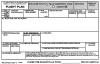
e. Flight Plan Form-
See FIG 5-1-2.
f. Explanation of
IFR Flight Plan Items.
1. Block 1.
Check the type flight plan. Check
both the VFR and IFR blocks if composite VFR/IFR.
2. Block 2.
Enter your complete aircraft
identification including the prefix "N" if
applicable.
3. Block 3.
Enter the designator for the
aircraft, followed by a slant(/), and the
transponder or DME equipment code letter; e.g.,
C-182/U. Heavy aircraft, add prefix "H" to aircraft
type; example: H/DC10/U. Consult an FSS briefer for
any unknown elements.
4. Block 4.
Enter your computed true airspeed
(TAS).
NOTE-
If the average TAS changes plus or minus 5 percent
or 10 knots, whichever is greater, advise ATC.
5. Block 5.
Enter the departure airport
identifier code (or the name if the identifier is
unknown).
NOTE-
Use of identifier codes will expedite the processing
of your flight plan.
6. Block 6.
Enter the proposed departure time in Coordinated
Universal Time (UTC) (Z). If airborne, specify the
actual or proposed departure time as appropriate.
7. Block 7.
Enter the requested en route
altitude or flight level.
NOTE-
Enter only the initial requested altitude in this
block. When more than one IFR altitude or flight
level is desired along the route of flight, it is
best to make a subsequent request direct to the
controller.
8. Block 8.
Define the route of flight by
using NAVAID identifier codes (or names if the code
is unknown), airways, jet routes, and waypoints (for
RNAV).
NOTE-
Use NAVAID's or waypoint's to define direct routes
and radials/bearings to define other unpublished
routes.
9. Block 9.
Enter the destination airport
identifier code (or name if the identifier is
unknown).
10. Block 10.
Enter your estimated time
en route based on latest forecast winds.
11. Block 11.
Enter only those remarks
pertinent to ATC or to the clarification of other
flight plan information, such as the appropriate
radiotelephony (call sign) associated with the
designator filed in Block 2. Items of a personal
nature are not accepted. Do not assume that remarks
will be automatically transmitted to every
controller. Specific ATC or en route requests should
be made directly to the appropriate controller.
NOTE-
"DVRSN" should be placed in Block 11 only if the
pilot/company is requesting priority handling to
their original destination from ATC as a result of a
diversion as defined in the Pilot/Controller
Glossary.
12. Block 12.
Specify the fuel on board,
computed from the departure point.
13. Block 13.
Specify an alternate
airport if desired or required, but do not include
routing to the alternate airport.
14. Block 14.
Enter the complete name,
address, and telephone number of pilot-in-command,
or in the case of a formation flight, the formation
commander. Enter sufficient information to identify
home base, airport, or operator.
NOTE-
This information would be essential in the event of
search and rescue operation.
15. Block 15.
Enter the total number of
persons on board including crew.
16. Block 16.
Enter the predominant
colors.
NOTE-
Close IFR flight plans with tower, approach control,
or ARTCC, or if unable, with FSS. When landing at an
airport with a functioning control tower, IFR flight
plans are automatically canceled.
g.
The information transmitted to the
ARTCC for IFR flight plans will consist of only flight
plan blocks 2, 3, 4, 5, 6, 7, 8, 9, 10, and 11.
h.
A description of the International
Flight Plan Form is contained in the International
Flight Information Manual (IFIM).
FIG 5-1-2
FAA Flight Plan
Form 7233-1 (8-82)
5-1-8.
IFR Operations to High Altitude Destinations
a.
Pilots planning IFR flights to airports
located in mountainous terrain are cautioned to
consider the necessity for an alternate airport even
when the forecast weather conditions would technically
relieve them from the requirement to file one.
REFERENCE-
14 CFR Section 91.167.
AIM, Tower En Route Control (TEC), Paragraph 4-1-18.
b.
The FAA has identified three possible
situations where the failure to plan for an alternate
airport when flying IFR to such a destination airport
could result in a critical situation if the weather is
less than forecast and sufficient fuel is not
available to proceed to a suitable airport.
1.
An IFR flight to an airport where the
Minimum Descent Altitudes (MDA's) or landing
visibility minimums for all instrument approaches
are higher than the forecast weather minimums
specified in 14 CFR Section 91.167(b). For example,
there are 3 high altitude airports in the U.S. with
approved instrument approach procedures where all of
the MDA's are greater than 2,000 feet and/or the
landing visibility minimums are greater than 3 miles
(Bishop, California; South Lake Tahoe, California;
and Aspen-Pitkin Co./Sardy Field, Colorado). In the
case of these airports, it is possible for a pilot
to elect, on the basis of forecasts, not to carry
sufficient fuel to get to an alternate when the
ceiling and/or visibility is actually lower than
that necessary to complete the approach.
2.
A small number of other airports in
mountainous terrain have MDA's which are slightly
(100 to 300 feet) below 2,000 feet AGL. In
situations where there is an option as to whether to
plan for an alternate, pilots should bear in mind
that just a slight worsening of the weather
conditions from those forecast could place the
airport below the published IFR landing minimums.
3.
An IFR flight to an airport which
requires special equipment; i.e., DME, glide slope,
etc., in order to make the available approaches to
the lowest minimums. Pilots should be aware that all
other minimums on the approach charts may require
weather conditions better than those specified in 14
CFR Section 91.167(b). An inflight equipment
malfunction could result in the inability to comply
with the published approach procedures or, again, in
the position of having the airport below the
published IFR landing minimums for all remaining
instrument approach alternatives.
5-1-9. Flights
Outside the U.S. and U.S. Territories
a.
When conducting flights, particularly
extended flights, outside the U.S. and its
territories, full account should be taken of the
amount and quality of air navigation services
available in the airspace to be traversed. Every
effort should be made to secure information on the
location and range of navigational aids, availability
of communications and meteorological services, the
provision of air traffic services, including alerting
service, and the existence of search and rescue
services.
b.
Pilots should remember that there is a
need to continuously guard the VHF emergency frequency
121.5 MHz when on long over-water flights, except when
communications on other VHF channels, equipment
limitations, or cockpit duties prevent simultaneous
guarding of two channels. Guarding of 121.5 MHz is
particularly critical when operating in proximity to
Flight Information Region (FIR) boundaries, for
example, operations on Route R220 between Anchorage
and Tokyo, since it serves to facilitate
communications with regard to aircraft which may
experience in-flight emergencies, communications, or
navigational difficulties.
REFERENCE-
ICAO Annex 10, Vol II, Paras 5.2.2.1.1.1 and
5.2.2.1.1.2.
c.
The filing of a flight plan, always
good practice, takes on added significance for
extended flights outside U.S. airspace and is, in
fact, usually required by the laws of the countries
being visited or overflown. It is also particularly
important in the case of such flights that pilots
leave a complete itinerary and schedule of the flight
with someone directly concerned and keep that person
advised of the flight's progress. If serious doubt
arises as to the safety of the flight, that person
should first contact the appropriate FSS. Round Robin
Flight Plans to Mexico are not accepted.
d.
All pilots should review the foreign
airspace and entry restrictions published in the IFIM
during the flight planning process. Foreign airspace
penetration without official authorization can involve
both danger to the aircraft and the imposition of
severe penalties and inconvenience to both passengers
and crew. A flight plan on file with ATC authorities
does not necessarily constitute the prior permission
required by certain other authorities. The possibility
of fatal consequences cannot be ignored in some areas
of the world.
e.
Current NOTAM's for foreign locations
must also be reviewed. The publication Notices to
Airmen, Domestic/International, published biweekly,
contains considerable information pertinent to foreign
flight. Current foreign NOTAM's are also available
from the U.S. International NOTAM Office in
Washington, D.C., through any local FSS.
f.
When customs notification is required,
it is the responsibility of the pilot to arrange for
customs notification in a timely manner. The following
guidelines are applicable:
1.
When customs notification is required
on flights to Canada and Mexico and a predeparture
flight plan cannot be filed or an advise customs
message (ADCUS) cannot be included in a predeparture
flight plan, call the nearest en route domestic or
International FSS as soon as radio communication can
be established and file a VFR or DVFR flight plan,
as required, and include as the last item the advise
customs information. The station with which such a
flight plan is filed will forward it to the
appropriate FSS who will notify the customs office
responsible for the destination airport.
2.
If the pilot fails to include ADCUS
in the radioed flight plan, it will be assumed that
other arrangements have been made and FAA will not
advise customs.
3.
The FAA assumes no responsibility for
any delays in advising customs if the flight plan is
given too late for delivery to customs before
arrival of the aircraft. It is still the pilot's
responsibility to give timely notice even though a
flight plan is given to FAA.
4.
Air Commerce Regulations of the
Treasury Department's Customs Service require all
private aircraft arriving in the U.S. via:
(a)
The U.S./Mexican border or the
Pacific Coast from a foreign place in the Western
Hemisphere south of 33 degrees north latitude and
between 97 degrees and 120 degrees west longitude;
or
(b)
The Gulf of Mexico and Atlantic
Coasts from a foreign place in the Western
Hemisphere south of 30 degrees north latitude,
shall furnish a notice of arrival to the Customs
service at the nearest designated airport. This
notice may be furnished directly to Customs by:
(1)
Radio through the appropriate
FAA Flight Service Station.
(2)
Normal FAA flight plan
notification procedures (a flight plan filed in
Mexico does not meet this requirement due to
unreliable relay of data); or
(3)
Directly to the district
Director of Customs or other Customs officer at
place of first intended landing but must be
furnished at least 1 hour prior to crossing the
U.S./Mexican border or the U.S. coastline.
(c)
This notice will be valid as long
as actual arrival is within 15 minutes of the
original ETA, otherwise a new notice must be given
to Customs. Notices will be accepted up to 23
hours in advance. Unless an exemption has been
granted by Customs, private aircraft are required
to make first landing in the U.S. at one of the
following designated airports nearest to the point
of border of coastline crossing:
Designated Airports
|
ARIZONA
|
|
Bisbee Douglas Intl
Airport |
|
Douglas Municipal
Airport |
|
Nogales Intl
Airport |
|
Tucson Intl Airport
|
|
Yuma MCAS-Yuma Intl
Airport |
|
CALIFORNIA
|
|
Calexico Intl
Airport |
|
Brown Field
Municipal Airport (San Diego) |
|
FLORIDA
|
|
Fort Lauderdale
Executive Airport |
|
Fort
Lauderdale/Hollywood Intl Airport |
|
Key West Intl
Airport (Miami Intl Airport) |
|
Opa Locka Airport
(Miami) |
|
Kendall-Tamiami
Executive Airport (Miami) |
|
St. Lucie County
Intl Airport (Fort Pierce) |
|
Tampa Intl Airport
|
|
Palm Beach Intl
Airport (West Palm Beach) |
|
LOUISANA
|
|
New Orleans Intl
Airport (Moisant Field) |
|
New Orleans
Lakefront Airport |
|
NEW MEXICO
|
|
Las Cruces Intl
Airport |
|
NORTH CAROLINA
|
|
New Hanover Intl
Airport (Wilmington) |
|
TEXAS
|
|
Brownsville/South
Padre Island Intl Airport |
|
Corpus Christi Intl
Airport |
|
Del Rio Intl
Airport |
|
Eagle Pass
Municipal Airport |
|
El Paso Intl
Airport |
|
William P. Hobby
Airport (Houston) |
|
Laredo Intl Airport
|
|
McAllen Miller Intl
Airport |
|
Presidio Lely Intl
Airport |
5-1-10. Change in Flight Plan
In addition to altitude
or flight level, destination and/or route changes,
increasing or decreasing the speed of an aircraft
constitutes a change in a flight plan. Therefore, at any
time the average true airspeed at cruising altitude
between reporting points varies or is expected to vary
from that given in the flight plan by plus or minus 5
percent, or 10 knots, whichever is greater, ATC
should be advised.
5-1-11. Change in Proposed
Departure Time
a.
To prevent computer saturation in the
en route environment, parameters have been established
to delete proposed departure flight plans which have
not been activated. Most centers have this parameter
set so as to delete these flight plans a minimum of 1
hour after the proposed departure time. To ensure that
a flight plan remains active, pilots whose actual
departure time will be delayed 1 hour or more beyond
their filed departure time, are requested to notify
ATC of their departure time.
b.
Due to traffic saturation, control
personnel frequently will be unable to accept these
revisions via radio. It is recommended that you
forward these revisions to the nearest FSS.
5-1-12. Closing VFR/DVFR
Flight Plans
A pilot is responsible
for ensuring that his/her VFR or DVFR flight plan is
canceled. You should close your flight plan with the
nearest FSS, or if one is not available, you may request
any ATC facility to relay your cancellation to the FSS.
Control towers do not
automatically close VFR or DVFR flight plans since they
do not know if a particular VFR aircraft is on a flight
plan. If you fail to report or cancel your flight plan
within 1/2 hour after your ETA,
search and rescue procedures are started.
REFERENCE-
14 CFR Section 91.153.
14 CFR Section 91.169.
5-1-13.
Canceling IFR Flight Plan
a.
14 CFR Sections 91.153 and 91.169
include the statement "When a flight plan has been
activated, the pilot-in-command, upon canceling or
completing the flight under the flight plan, shall
notify an FAA Flight Service Station or ATC facility."
b.
An IFR flight plan may be canceled at
any time the flight is operating in VFR conditions
outside Class A airspace by pilots stating "CANCEL MY
IFR FLIGHT PLAN" to the controller or air/ground
station with which they are communicating. Immediately
after canceling an IFR flight plan, a pilot should
take the necessary action to change to the appropriate
air/ground frequency, VFR radar beacon code and VFR
altitude or flight level.
c.
ATC separation and information services
will be discontinued, including radar services (where
applicable). Consequently, if the canceling flight
desires VFR radar advisory service, the pilot must
specifically request it.
NOTE-
Pilots must be aware that other procedures may be
applicable to a flight that cancels an IFR flight plan
within an area where a special program, such as a
designated TRSA, Class C airspace, or Class B
airspace, has been established.
d.
If a DVFR flight plan requirement
exists, the pilot is responsible for filing this
flight plan to replace the canceled IFR flight plan.
If a subsequent IFR operation becomes necessary, a new
IFR flight plan must be filed and an ATC clearance
obtained before operating in IFR conditions.
e.
If operating on an IFR flight plan to
an airport with a functioning control tower, the
flight plan is automatically closed upon landing.
f.
If operating on an IFR flight plan to
an airport where there is no functioning control
tower, the pilot must initiate cancellation of the IFR
flight plan. This can be done after landing if there
is a functioning FSS or other means of direct
communications with ATC. In the event there is no FSS
and/or air/ground communications with ATC is not
possible below a certain altitude, the pilot should,
weather conditions permitting, cancel the IFR flight
plan while still airborne and able to communicate with
ATC by radio. This will not only save the time and
expense of canceling the flight plan by telephone but
will quickly release the airspace for use by other
aircraft.

|