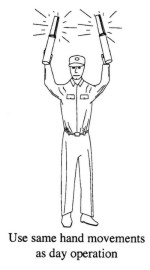
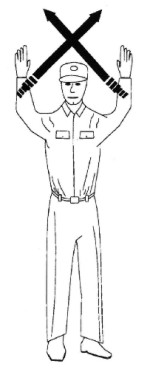
|
4-3-1.
General
Increased traffic congestion,
aircraft in climb and descent attitudes, and pilot
preoccupation with cockpit duties are some factors that
increase the hazardous accident potential near the airport.
The situation is further compounded when the weather is
marginal, that is, just meeting VFR requirements. Pilots
must be particularly alert when operating in the vicinity of
an airport. This section defines some rules, practices, and
procedures that pilots should be familiar with and adhere to
for safe airport operations.
4-3-2.
Airports with an Operating Control Tower
a.
When operating at an airport where traffic
control is being exercised by a control tower, pilots are
required to maintain two-way radio contact with the tower
while operating within the Class B, Class C, and Class D
surface area unless the tower authorizes otherwise.
Initial callup should be made about 15 miles from the
airport. Unless there is a good reason to leave the tower
frequency before exiting the Class B, Class C, and Class D
surface areas, it is a good operating practice to remain
on the tower frequency for the purpose of receiving
traffic information. In the interest of reducing tower
frequency congestion, pilots are reminded that it is not
necessary to request permission to leave the tower
frequency once outside of Class B, Class C, and Class D
surface areas. Not all airports with an operating control
tower will have Class D airspace. These airports do not
have weather reporting which is a requirement for surface
based controlled airspace, previously known as a control
zone. The controlled airspace over these airports will
normally begin at 700 feet or 1,200 feet above ground
level and can be determined from the visual aeronautical
charts. Pilots are expected to use good operating
practices and communicate with the control tower as
described in this section.
b.
When necessary, the tower controller will
issue clearances or other information for aircraft to
generally follow the desired flight path (traffic
patterns) when flying in Class B, Class C, and Class D
surface areas and the proper taxi routes when operating on
the ground. If not otherwise authorized or directed by the
tower, pilots of fixed-wing aircraft approaching to land
must circle the airport to the left. Pilots approaching to
land in a helicopter must avoid the flow of fixed-wing
traffic. However, in all instances, an appropriate
clearance must be received from the tower before landing.
FIG 4-3-1
Components of a Traffic
Pattern
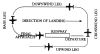
NOTE-
This diagram is intended only to illustrate terminology
used in identifying various components of a traffic
pattern. It should not be used as a reference or guide on
how to enter a traffic pattern.
c.
The following terminology for the various
components of a traffic pattern has been adopted as
standard for use by control towers and pilots (See FIG
4-3-1):
1. Upwind leg.
A flight path parallel to the landing
runway in the direction of landing.
2. Crosswind leg.
A flight path at right angles
to the landing runway off its takeoff end.
3. Downwind leg.
A flight path parallel to the
landing runway in the opposite direction of landing.
4. Base leg.
A flight path at right angles to the
landing runway off its approach end and extending from
the downwind leg to the intersection of the extended
runway centerline.
5. Final approach.
A flight path in the direction
of landing along the extended runway centerline from the
base leg to the runway.
6. Departure leg.
The flight path which begins
after takeoff and continues straight ahead along the
extended runway centerline. The departure climb
continues until reaching a point at least 1/2
mile beyond the departure end of the runway and within
300 feet of the traffic pattern altitude.
d.
Many towers are equipped with a tower radar
display. The radar uses are intended to enhance the
effectiveness and efficiency of the local control, or
tower, position. They are not intended to provide radar
services or benefits to pilots except as they may accrue
through a more efficient tower operation. The four basic
uses are:
1. To determine an
aircraft's exact location.
This is accomplished by radar identifying the VFR
aircraft through any of the techniques available to a
radar position, such as having the aircraft squawk
ident. Once identified, the aircraft's position and
spatial relationship to other aircraft can be quickly
determined, and standard instructions regarding VFR
operation in Class B, Class C, and Class D surface areas
will be issued. Once initial radar identification of a
VFR aircraft has been established and the appropriate
instructions have been issued, radar monitoring may be
discontinued; the reason being that the local
controller's primary means of surveillance in VFR
conditions is visually scanning the airport and local
area.
2. To provide radar
traffic advisories.
Radar
traffic advisories may be provided to the extent that
the local controller is able to monitor the radar
display. Local control has primary control
responsibilities to the aircraft operating on the
runways, which will normally supersede radar monitoring
duties.
3. To provide a
direction or suggested heading.
The local controller may provide pilots
flying VFR with generalized instructions which will
facilitate operations; e.g., "PROCEED SOUTHWESTBOUND,
ENTER A RIGHT DOWNWIND RUNWAY THREE ZERO," or provide a
suggested heading to establish radar identification or
as an advisory aid to navigation; e.g., "SUGGESTED
HEADING TWO TWO ZERO, FOR RADAR IDENTIFICATION." In both
cases, the instructions are advisory aids to the pilot
flying VFR and are not radar vectors.
NOTE-
Pilots have complete discretion regarding acceptance of
the suggested headings or directions and have sole
responsibility for seeing and avoiding other
aircraft.
4. To provide
information and instructions to aircraft operating
within Class B, Class C, and Class D surface areas.
In an example of this
situation, the local controller would use the radar to
advise a pilot on an extended downwind when to turn base
leg.
NOTE-
The above tower radar applications are intended to
augment the standard functions of the local control
position. There is no controller requirement to maintain
constant radar identification. In fact, such a
requirement could compromise the local controller's
ability to visually scan the airport and local area to
meet FAA responsibilities to the aircraft operating on
the runways and within the Class B, Class C, and Class D
surface areas. Normally, pilots will not be advised of
being in radar contact since that continued status
cannot be guaranteed and since the purpose of the radar
identification is not to establish a link for the
provision of radar services.
e.
A few of the radar equipped towers are
authorized to use the radar to ensure separation between
aircraft in specific situations, while still others may
function as limited radar approach controls. The various
radar uses are strictly a function of FAA operational
need. The facilities may be indistinguishable to pilots
since they are all referred to as tower and no publication
lists the degree of radar use. Therefore, when in
communication with a tower controller who may have radar
available, do not assume that constant radar monitoring
and complete ATC radar services are being provided.

4-3-3.
Traffic Patterns
At most airports and military
air bases, traffic pattern altitudes for propeller-driven
aircraft generally extend from 600 feet to as high as 1,500
feet above the ground. Also, traffic pattern altitudes for
military turbojet aircraft sometimes extend up to 2,500 feet
above the ground. Therefore, pilots of en route aircraft
should be constantly on the alert for other aircraft in
traffic patterns and avoid these areas whenever possible.
Traffic pattern altitudes should be maintained unless
otherwise required by the applicable distance from cloud
criteria (14 CFR Section 91.155). (See
FIG 4-3-2 and FIG 4-3-3.)
FIG 4-3-2
Traffic Pattern
Operations
Single Runway
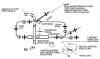
NOTE-
See Key to Traffic Pattern Operations under FIG 4-3-3.
FIG 4-3-3
Traffic Pattern
Operations
Parallel Runways
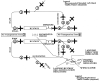
EXAMPLE-
Key to traffic pattern operations
1. Enter pattern
in level flight, abeam the midpoint of the runway, at
pattern altitude. (1,000' AGL is recommended pattern
altitude unless established otherwise. . .)
2. Maintain pattern altitude until abeam
approach end of the landing runway on downwind leg.
3. Complete turn to final at least 1/4
mile from the runway.
4. Continue straight ahead until beyond
departure end of runway.
5. If remaining in the traffic pattern,
commence turn to crosswind leg beyond the departure end
of the runway within 300 feet of pattern altitude.
6. If departing the
traffic pattern, continue straight out, or exit with a
45 degree turn (to the left when in a left-hand traffic
pattern; to the right when in a right-hand traffic
pattern) beyond the departure end of the runway, after
reaching pattern altitude.
7.
Do not overshoot final or continue on
a track which will penetrate the final approach of the
parallel runway.
8. Do not continue on a track which will
penetrate the departure path of the parallel runway.
4-3-4.
Visual Indicators at Airports Without an Operating Control
Tower
a.
At those airports without an operating
control tower, a segmented circle visual indicator
system, if installed, is designed to provide traffic
pattern information.
REFERENCE-
AIM, Traffic Advisory Practices at Airports Without
Operating Control Towers, Paragraph
4-1-9.
b.
The segmented circle system consists of the
following components:
1. The segmented
circle. Located in a position
affording maximum visibility to pilots in the air and on
the ground and providing a centralized location for
other elements of the system.
2. The wind
direction indicator.
A wind
cone, wind sock, or wind tee installed near the
operational runway to indicate wind direction. The large
end of the wind cone/wind sock points into the wind as
does the large end (cross bar) of the wind tee. In lieu
of a tetrahedron and where a wind sock or wind cone is
collocated with a wind tee, the wind tee may be manually
aligned with the runway in use to indicate landing
direction. These signaling devices may be located in the
center of the segmented circle and may be lighted for
night use. Pilots are cautioned against using a
tetrahedron to indicate wind direction.
3. The landing
direction indicator.
A
tetrahedron is installed when conditions at the airport
warrant its use. It may be used to indicate the
direction of landings and takeoffs. A tetrahedron may be
located at the center of a segmented circle and may be
lighted for night operations. The small end of the
tetrahedron points in the direction of landing. Pilots
are cautioned against using a tetrahedron for any
purpose other than as an indicator of landing direction.
Further, pilots should use extreme caution when making
runway selection by use of a tetrahedron in very light
or calm wind conditions as the tetrahedron may not be
aligned with the designated calm-wind runway. At
airports with control towers, the tetrahedron should
only be referenced when the control tower is not in
operation. Tower instructions supersede tetrahedron
indications.
4. Landing strip
indicators. Installed in pairs
as shown in the segmented circle diagram and used to
show the alignment of landing strips.
5. Traffic pattern
indicators. Arranged in pairs
in conjunction with landing strip indicators and used to
indicate the direction of turns when there is a
variation from the normal left traffic pattern. (If
there is no segmented circle installed at the airport,
traffic pattern indicators may be installed on or near
the end of the runway.)
c.
Preparatory to landing at an airport
without a control tower, or when the control tower is not
in operation, pilots should concern themselves with the
indicator for the approach end of the runway to be used.
When approaching for landing, all turns must be made to
the left unless a traffic pattern indicator indicates that
turns should be made to the right. If the pilot will
mentally enlarge the indicator for the runway to be used,
the base and final approach legs of the traffic pattern to
be flown immediately become apparent. Similar treatment of
the indicator at the departure end of the runway will
clearly indicate the direction of turn after takeoff.
d.
When two or more aircraft are approaching
an airport for the purpose of landing, the pilot of the
aircraft at the lower altitude has the right-of-way over
the pilot of the aircraft at the higher altitude. However,
the pilot operating at the lower altitude should not take
advantage of another aircraft, which is on final approach
to land, by cutting in front of, or overtaking that
aircraft.
4-3-5.
Unexpected Maneuvers in the Airport Traffic Pattern
There have been several
incidents in the vicinity of controlled airports that were
caused primarily by aircraft executing unexpected maneuvers.
ATC service is based upon observed or known traffic and
airport conditions. Controllers establish the sequence of
arriving and departing aircraft by requiring them to adjust
flight as necessary to achieve proper spacing. These
adjustments can only be based on observed traffic, accurate
pilot reports, and anticipated aircraft maneuvers. Pilots
are expected to cooperate so as to preclude disrupting
traffic flows or creating conflicting patterns. The
pilot-in-command of an aircraft is directly responsible for
and is the final authority as to the operation of the
aircraft. On occasion it may be necessary for pilots to
maneuver their aircraft to maintain spacing with the traffic
they have been sequenced to follow. The controller can
anticipate minor maneuvering such as shallow "S" turns. The
controller cannot, however, anticipate a major maneuver such
as a 360 degree turn. If a pilot makes a 360 degree turn
after obtaining a landing sequence, the result is usually a
gap in the landing interval and, more importantly, it causes
a chain reaction which may result in a conflict with
following traffic and an interruption of the sequence
established by the tower or approach controller. Should a
pilot decide to make maneuvering turns to maintain spacing
behind a preceding aircraft, the pilot should always advise
the controller if at all possible. Except when requested by
the controller or in emergency situations, a 360 degree turn
should never be executed in the traffic pattern or when
receiving radar service without first advising the
controller.
4-3-6.
Use of Runways/Declared Distances
a.
Runways are identified by numbers which
indicate the nearest 10-degree increment of the azimuth of
the runway centerline. For example, where the magnetic
azimuth is 183 degrees, the runway designation would be
18; for a magnetic azimuth of 87 degrees, the runway
designation would be 9. For a magnetic azimuth ending in
the number 5, such as 185, the runway designation could be
either 18 or 19. Wind direction issued by the tower is
also magnetic and wind velocity is in knots.
b.
Airport proprietors are responsible for
taking the lead in local aviation noise control.
Accordingly, they may propose specific noise abatement
plans to the FAA. If approved, these plans are applied in
the form of Formal or Informal Runway Use Programs for
noise abatement purposes.
REFERENCE-
Pilot/Controller Glossary Term- Runway Use Program.
1.
At airports where no runway use program
is established, ATC clearances may specify:
(a)
The runway most nearly aligned with the
wind when it is 5 knots or more;
(b)
The "calm wind" runway when wind is
less than 5 knots; or
(c)
Another runway if operationally
advantageous.
NOTE-
It is not necessary for a controller to specifically
inquire if the pilot will use a specific runway or to
offer a choice of runways. If a pilot prefers to use a
different runway from that specified or the one most
nearly aligned with the wind, the pilot is expected to
inform ATC accordingly.
2.
At airports where a runway use program is
established, ATC will assign runways deemed to have the
least noise impact. If in the interest of safety a
runway different from that specified is preferred, the
pilot is expected to advise ATC accordingly. ATC will
honor such requests and advise pilots when the requested
runway is noise sensitive. When use of a runway other
than the one assigned is requested, pilot cooperation is
encouraged to preclude disruption of traffic flows or
the creation of conflicting patterns.
c.
At some airports, the airport proprietor
may declare that sections of a runway at one or both ends
are not available for landing or takeoff. For these
airports, the declared distance of runway length available
for a particular operation is published in the
Airport/Facility Directory. Declared distances (TORA,
TODA, ASDA, and LDA) are defined in the
Pilot/Controller Glossary. These distances are
calculated by adding to the full length of paved runway
any applicable clearway or stopway and subtracting from
that sum the sections of the runway unsuitable for
satisfying the required takeoff run, takeoff,
accelerate/stop, or landing distance.
4-3-7.
Low Level Wind Shear Alert System (LLWAS) and Terminal
Doppler Weather Radar (TDWR)
LLWAS and TDWR are systems designed to provide pilots
with information on hazardous wind shear and microburst
activity in the vicinity of an airport. Not all airports
will have this capability, but more than half of the towered
airports will have the capability to provide some level of
alert.
a.
At airports equipped with LLWAS,
controllers are provided with gust front wind shear
information. Controllers will provide this information to
pilots by giving the pilot the airport wind followed by
the boundary wind.
EXAMPLE-
Wind shear alert, airport wind 230 at 8, south boundary
wind 170 at 20.
NOTE-
The LLWAS is designed to detect low level wind shear
conditions around the periphery of an airport. It does not
detect wind shear beyond that limitation.
b.
Airports equipped with LLWAS "network
expansion," LLWAS systems integrated with TDWR and TDWR
systems provide the capability of detecting microburst
alerts and wind shear alerts. Controllers will issue the
appropriate wind shear alerts or microburst alerts. In
some of these systems controllers also have the ability to
issue wind information oriented to the threshold or
departure end of the runway.
EXAMPLE-
Runway 17 arrival microburst alert, 40 knot loss 3 mile
final.
REFERENCE-
AIM, Microbursts, Paragraph
7-1-24.
c.
An airport equipped with the LLWAS is so
indicated in the Airport/Facility Directory under Weather
Data Sources for that particular airport.
4-3-8.
Braking Action Reports and Advisories
a.
When available, ATC furnishes pilots the
quality of braking action received from pilots or airport
management. The quality of braking action is described by
the terms "good," "fair," "poor," and "nil," or a
combination of these terms. When pilots report the quality
of braking action by using the terms noted above, they
should use descriptive terms that are easily understood,
such as, "braking action poor the first/last half of the
runway," together with the particular type of aircraft.
b.
For NOTAM purposes, braking action reports
are classified according to the most critical term
("fair," "poor," or "nil") used and issued as a NOTAM(D).
c.
When tower controllers have received runway
braking action reports which include the terms poor
or nil, or whenever weather conditions are
conducive to deteriorating or rapidly changing runway
braking conditions, the tower will include on the ATIS
broadcast the statement, "BRAKING ACTION ADVISORIES ARE
IN EFFECT."
d.
During the time that braking action
advisories are in effect, ATC will issue the latest
braking action report for the runway in use to each
arriving and departing aircraft. Pilots should be prepared
for deteriorating braking conditions and should request
current runway condition information if not volunteered by
controllers. Pilots should also be prepared to provide a
descriptive runway condition report to controllers after
landing.
4-3-9.
Runway Friction Reports and Advisories
a.
Friction is defined as the ratio of the
tangential force needed to maintain uniform relative
motion between two contacting surfaces (aircraft tires to
the pavement surface) to the perpendicular force holding
them in contact (distributed aircraft weight to the
aircraft tire area). Simply stated, friction quantifies
slipperiness of pavement surfaces.
b.
The greek letter MU (pronounced "myew"), is
used to designate a friction value representing runway
surface conditions.
c.
MU (friction) values range from 0 to 100
where zero is the lowest friction value and 100 is the
maximum friction value obtainable. For frozen contaminants
on runway surfaces, a MU value of 40 or less is the level
when the aircraft braking performance starts to
deteriorate and directional control begins to be less
responsive. The lower the MU value, the less effective
braking performance becomes and the more difficult
directional control becomes.
d.
At airports with friction measuring
devices, airport management should conduct friction
measurements on runways covered with compacted snow and/or
ice.
1.
Numerical readings may be obtained by
using any FAA approved friction measuring device. As
these devices do not provide equal numerical readings on
contaminated surfaces, it is necessary to designate the
type of friction measuring device used.
2.
When the MU value for any one-third zone
of an active runway is 40 or less, a report should be
given to ATC by airport management for dissemination to
pilots. The report will identify the runway, the time of
measurement, the type of friction measuring device used,
MU values for each zone, and the contaminant conditions,
e.g., wet snow, dry snow, slush, deicing chemicals, etc.
Measurements for each one-third zone will be given in
the direction of takeoff and landing on the runway. A
report should also be given when MU values rise above 40
in all zones of a runway previously reporting a MU below
40.
3.
Airport management should initiate a
NOTAM(D) when the friction measuring device is out of
service.
e.
When MU reports are provided by airport
management, the ATC facility providing approach control or
local airport advisory will provide the report to any
pilot upon request.
f.
Pilots should use MU information with other
knowledge including aircraft performance characteristics,
type, and weight, previous experience, wind conditions,
and aircraft tire type (i.e., bias ply vs. radial
constructed) to determine runway suitability.
g.
No correlation has been established between
MU values and the descriptive terms "good," "fair,"
"poor," and "nil" used in braking action reports.
4-3-10.
Intersection Takeoffs
a.
In order to enhance airport capacities,
reduce taxiing distances, minimize departure delays, and
provide for more efficient movement of air traffic,
controllers may initiate intersection takeoffs as well as
approve them when the pilot requests. If for ANY reason a
pilot prefers to use a different intersection or the full
length of the runway or desires to obtain the distance
between the intersection and the runway end, THE PILOT IS
EXPECTED TO INFORM ATC ACCORDINGLY.
b.
An aircraft is expected to taxi to (but not
onto) the end of the assigned runway unless prior approval
for an intersection departure is received from ground
control.
c.
Pilots should state their position on the
airport when calling the tower for takeoff from a runway
intersection.
EXAMPLE-
Cleveland Tower, Apache Three Seven Two Two Papa, at the
intersection of taxiway Oscar and runway two three right,
ready for departure.
d.
Controllers are required to separate small
aircraft (12,500 pounds or less, maximum certificated
takeoff weight) departing (same or opposite direction)
from an intersection behind a large nonheavy aircraft on
the same runway, by ensuring that at least a 3-minute
interval exists between the time the preceding large
aircraft has taken off and the succeeding small aircraft
begins takeoff roll. To inform the pilot of the required
3-minute hold, the controller will state, "Hold for wake
turbulence." If after considering wake turbulence hazards,
the pilot feels that a lesser time interval is
appropriate, the pilot may request a waiver to the
3-minute interval. To initiate such a request, simply say
"Request waiver to 3-minute interval," or a similar
statement. Controllers may then issue a takeoff clearance
if other traffic permits, since the pilot has accepted the
responsibility for wake turbulence separation.
e.
The 3-minute interval is not required when
the intersection is 500 feet or less from the departure
point of the preceding aircraft and both aircraft are
taking off in the same direction. Controllers may permit
the small aircraft to alter course after takeoff to avoid
the flight path of the preceding departure.
f.
The 3-minute interval is mandatory behind a
heavy aircraft in all cases.
4-3-11.
Pilot Responsibilities When Conducting Land and Hold Short
Operations (LAHSO)
a.
LAHSO is an acronym for "Land and Hold
Short Operations." These operations include landing and
holding short of an intersecting runway, an
intersecting taxiway, or some other designated
point on a runway other than an intersecting runway or
taxiway. (See
FIG 4-3-4,
FIG 4-3-5,
FIG 4-3-6.)
b. Pilot
Responsibilities and Basic Procedures.
1.
LAHSO is an air traffic control procedure
that requires pilot participation to balance the needs
for increased airport capacity and system efficiency,
consistent with safety. This procedure can be done
safely provided pilots and controllers are
knowledgeable and understand their responsibilities. The
following paragraphs outline specific pilot/operator
responsibilities when conducting LAHSO.
2.
At controlled airports, air traffic may
clear a pilot to land and hold short. Pilots may accept
such a clearance provided that the pilot-in-command
determines that the aircraft can safely land and stop
within the Available Landing Distance (ALD). ALD data
are published in the special notices section of the
Airport/Facility Directory (A/FD) and in the
U.S. Terminal Procedures Publications.
Controllers will also provide ALD data upon request.
Student pilots or pilots not familiar with LAHSO should
not participate in the program.
3. The
pilot-in-command has the final authority to accept or
decline any land and hold short clearance. The safety
and operation of the aircraft remain the responsibility
of the pilot. Pilots are expected to decline a LAHSO
clearance if they determine it will compromise safety.
4.
To conduct LAHSO, pilots should become
familiar with all available information concerning LAHSO
at their destination airport. Pilots should have,
readily available, the published ALD and
runway slope information for all LAHSO
runway combinations at each airport of intended
landing. Additionally, knowledge about landing
performance data permits the pilot to readily
determine that the ALD for the assigned runway is
sufficient for safe LAHSO. As part of a pilot's
preflight planning process, pilots should determine if
their destination airport has LAHSO. If so, their
preflight planning process should include an assessment
of which LAHSO combinations would work for them given
their aircraft's required landing distance. Good pilot
decision making is knowing in advance whether one can
accept a LAHSO clearance if offered.
FIG 4-3-4
Land and Hold Short of
an Intersecting Runway
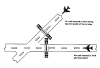
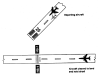
EXAMPLE-
FIG 4-3-6 - holding short at a designated point may
be required to avoid conflicts with the runway safety
area/flight path of a nearby runway.
NOTE-
Each figure shows the approximate location of LAHSO
markings, signage, and in-pavement lighting when
installed.
REFERENCE-
AIM,
Chapter 2, Aeronautical Lighting and Other Airport
Visual Aids.
FIG 4-3-5
Land and Hold Short of
an Intersecting Taxiway
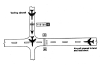
FIG 4-3-6
Land and Hold Short of a
Designated Point on a Runway
Other Than an Intersecting Runway or Taxiway
5.
If, for any reason, such as difficulty in
discerning the location of a LAHSO intersection, wind
conditions, aircraft condition, etc., the pilot elects
to request to land on the full length of the runway, to
land on another runway, or to decline LAHSO, a pilot is
expected to promptly inform air traffic, ideally even
before the clearance is issued. A LAHSO clearance,
once accepted, must be adhered to, just as any other ATC
clearance, unless an amended clearance is obtained or an
emergency occurs. A LAHSO clearance does not preclude a
rejected landing.
6.
A pilot who accepts a LAHSO clearance
should land and exit the runway at the first convenient
taxiway (unless directed otherwise) before reaching the
hold short point. Otherwise, the pilot must stop and
hold at the hold short point. If a rejected landing
becomes necessary after accepting a LAHSO clearance, the
pilot should maintain safe separation from other
aircraft or vehicles, and should promptly notify the
controller.
7.
Controllers need a full read back of all
LAHSO clearances. Pilots should read back their LAHSO
clearance and include the words, "HOLD SHORT OF
(RUNWAY/TAXIWAY/OR POINT)" in their acknowledgment of
all LAHSO clearances. In order to reduce frequency
congestion, pilots are encouraged to read back the LAHSO
clearance without prompting. Don't make the controller
have to ask for a read back!
c. LAHSO Situational
Awareness
1.
Situational awareness is vital to
the success of LAHSO. Situational awareness starts with
having current airport information in the cockpit,
readily accessible to the pilot. (An airport diagram
assists pilots in identifying their location on the
airport, thus reducing requests for "progressive taxi
instructions" from controllers.)
2.
Situational awareness includes effective
pilot-controller radio communication. ATC expects pilots
to specifically acknowledge and read back all LAHSO
clearances as follows:
EXAMPLE-
ATC: "(Aircraft ID) cleared to land runway six
right, hold short of taxiway bravo for crossing traffic
(type aircraft)."
Aircraft: "(Aircraft ID), wilco, cleared to land
runway six right to hold short of taxiway bravo."
ATC: "(Aircraft ID) cross runway six right at
taxiway bravo, landing aircraft will hold short."
Aircraft: "(Aircraft ID), wilco, cross runway six
right at bravo, landing traffic (type aircraft) to
hold."
3.
For those airplanes flown with two
crewmembers, effective intra-cockpit
communication between cockpit crewmembers is also
critical. There have been several instances where the
pilot working the radios accepted a LAHSO clearance but
then simply forgot to tell the pilot flying the
aircraft.
4.
Situational awareness also includes a
thorough understanding of the airport markings, signage,
and lighting associated with LAHSO. These visual aids
consist of a three-part system of yellow hold-short
markings, red and white signage and, in certain
cases, in-pavement lighting. Visual aids assist
the pilot in determining where to hold short.
FIG 4-3-4,
FIG 4-3-5,
FIG 4-3-6 depict how these markings, signage, and
lighting combinations will appear once installed. Pilots
are cautioned that not all airports conducting LAHSO
have installed any or all of the above markings,
signage, or lighting.
5.
Pilots should only receive a LAHSO
clearance when there is a minimum ceiling of 1,000 feet
and 3 statute miles visibility. The intent of having
"basic" VFR weather conditions is to allow pilots to
maintain visual contact with other aircraft and ground
vehicle operations. Pilots should consider the effects
of prevailing inflight visibility (such as landing into
the sun) and how it may affect overall situational
awareness. Additionally, surface vehicles and aircraft
being taxied by maintenance personnel may also be
participating in LAHSO, especially in those operations
that involve crossing an active runway.
4-3-12.
Low Approach
a.
A low approach (sometimes referred to as a
low pass) is the go-around maneuver following an approach.
Instead of landing or making a touch-and- go, a pilot may
wish to go around (low approach) in order to expedite a
particular operation (a series of practice instrument
approaches is an example of such an operation). Unless
otherwise authorized by ATC, the low approach should be
made straight ahead, with no turns or climb made until the
pilot has made a thorough visual check for other aircraft
in the area.
b.
When operating within a Class B, Class C,
and Class D surface area, a pilot intending to make a low
approach should contact the tower for approval. This
request should be made prior to starting the final
approach.
c.
When operating to an airport, not within a
Class B, Class C, and Class D surface area, a pilot
intending to make a low approach should, prior to leaving
the final approach fix inbound (nonprecision approach) or
the outer marker or fix used in lieu of the outer marker
inbound (precision approach), so advise the FSS, UNICOM,
or make a broadcast as appropriate.
REFERENCE-
AIM, Traffic Advisory Practices at Airports Without
Operating Control Towers, Paragraph
4-1-9.
4-3-13. Traffic
Control Light Signals
a.
The following procedures are used by ATCT's
in the control of aircraft, ground vehicles, equipment,
and personnel not equipped with radio. These same
procedures will be used to control aircraft, ground
vehicles, equipment, and personnel equipped with radio if
radio contact cannot be established. ATC personnel use a
directive traffic control signal which emits an intense
narrow light beam of a selected color (either red, white,
or green) when controlling traffic by light signals.
b.
Although the traffic signal light offers
the advantage that some control may be exercised over
nonradio equipped aircraft, pilots should be cognizant of
the disadvantages which are:
1.
Pilots may not be looking at the control
tower at the time a signal is directed toward their
aircraft.
2.
The directions transmitted by a light
signal are very limited since only approval or
disapproval of a pilot's anticipated actions may be
transmitted. No supplement or explanatory information
may be transmitted except by the use of the "General
Warning Signal" which advises the pilot to be on the
alert.
c.
Between sunset and sunrise, a pilot wishing
to attract the attention of the control tower should turn
on a landing light and taxi the aircraft into a position,
clear of the active runway, so that light is visible to
the tower. The landing light should remain on until
appropriate signals are received from the tower.
d.
Air Traffic Control Tower Light Gun Signals.
(See TBL 4-3-1.)
TBL 4-3-1
|
Meaning
|
|
Color and Type of
Signal |
Movement of
Vehicles, Equipment and Personnel |
Aircraft on the
Ground |
Aircraft in Flight |
|
Steady green
|
Cleared to cross,
proceed or go |
Cleared for takeoff
|
Cleared to land
|
|
Flashing green
|
Not applicable
|
Cleared for taxi
|
Return for landing (to
be followed by steady green at the proper time)
|
|
Steady red |
STOP |
STOP |
Give way to other
aircraft and continue circling |
|
Flashing red
|
Clear the
taxiway/runway |
Taxi clear of the
runway in use |
Airport unsafe, do not
land |
|
Flashing white
|
Return to starting
point on airport |
Return to starting
point on airport |
Not applicable
|
|
Alternating red and
green |
Exercise extreme
caution |
Exercise extreme
caution |
Exercise extreme
caution |
e. During daylight hours, acknowledge tower
transmissions or light signals by moving the ailerons or
rudder. At night, acknowledge by blinking the landing or
navigation lights. If radio malfunction occurs after
departing the parking area, watch the tower for light
signals or monitor tower frequency.
4-3-14.
Communications
a.
Pilots of departing aircraft should
communicate with the control tower on the appropriate
ground control/clearance delivery frequency prior to
starting engines to receive engine start time, taxi and/or
clearance information. Unless otherwise advised by the
tower, remain on that frequency during taxiing and runup,
then change to local control frequency when ready to
request takeoff clearance.
NOTE-
Pilots are encouraged to monitor the local tower frequency
as soon as practical consistent with other ATC
requirements.
REFERENCE-
AIM, Automatic Terminal Information Service (ATIS),
Paragraph
4-1-13.
b.
The majority of ground control frequencies
are in the 121.6-121.9 MHz bandwidth. Ground control
frequencies are provided to eliminate frequency congestion
on the tower (local control) frequency and are limited to
communications between the tower and aircraft on the
ground and between the tower and utility vehicles on the
airport, provide a clear VHF channel for arriving and
departing aircraft. They are used for issuance of taxi
information, clearances, and other necessary contacts
between the tower and aircraft or other vehicles operated
on the airport. A pilot who has just landed should not
change from the tower frequency to the ground control
frequency until directed to do so by the controller.
Normally, only one ground control frequency is assigned at
an airport; however, at locations where the amount of
traffic so warrants, a second ground control frequency
and/or another frequency designated as a clearance
delivery frequency, may be assigned.
c.
A controller may omit the ground or local
control frequency if the controller believes the pilot
knows which frequency is in use. If the ground control
frequency is in the 121 MHz bandwidth the controller may
omit the numbers preceding the decimal point; e.g., 121.7,
"CONTACT GROUND POINT SEVEN." However, if any doubt exists
as to what frequency is in use, the pilot should promptly
request the controller to provide that information.
d.
Controllers will normally avoid issuing a
radio frequency change to helicopters, known to be
single-piloted, which are hovering, air taxiing, or flying
near the ground. At times, it may be necessary for pilots
to alert ATC regarding single pilot operations to minimize
delay of essential ATC communications. Whenever possible,
ATC instructions will be relayed through the frequency
being monitored until a frequency change can be
accomplished. You must promptly advise ATC if you are
unable to comply with a frequency change. Also, you should
advise ATC if you must land to accomplish the frequency
change unless it is clear the landing will have no impact
on other air traffic; e.g., on a taxiway or in a
helicopter operating area.
4-3-15. Gate
Holding Due to Departure Delays
a.
Pilots should contact ground control or
clearance delivery prior to starting engines as gate hold
procedures will be in effect whenever departure delays
exceed or are anticipated to exceed 15 minutes. The
sequence for departure will be maintained in accordance
with initial call up unless modified by flow control
restrictions. Pilots should monitor the ground control or
clearance delivery frequency for engine startup advisories
or new proposed start time if the delay changes.
b.
The tower controller will consider that
pilots of turbine-powered aircraft are ready for takeoff
when they reach the runway or warm-up block unless advised
otherwise.
4-3-16.
VFR Flights in Terminal Areas
Use reasonable restraint in
exercising the prerogative of VFR flight, especially in
terminal areas. The weather minimums and distances from
clouds are minimums. Giving yourself a greater margin in
specific instances is just good judgment.
a. Approach Area.
Conducting a VFR operation in a Class
B, Class C, Class D, and Class E surface area when the
official visibility is 3 or 4 miles is not prohibited, but
good judgment would dictate that you keep out of the
approach area.
b. Reduced Visibility.
It has always been recognized
that precipitation reduces forward visibility.
Consequently, although again it may be perfectly legal to
cancel your IFR flight plan at any time you can proceed
VFR, it is good practice, when precipitation is occurring,
to continue IFR operation into a terminal area until you
are reasonably close to your destination.
c. Simulated Instrument
Flights. In conducting simulated
instrument flights, be sure that the weather is good
enough to compensate for the restricted visibility of the
safety pilot and your greater concentration on your flight
instruments. Give yourself a little greater margin when
your flight plan lies in or near a busy airway or close to
an airport.
4-3-17.
VFR Helicopter Operations at Controlled Airports
a. General.
1.
The following ATC procedures and
phraseologies recognize the unique capabilities of
helicopters and were developed to improve service to all
users. Helicopter design characteristics and user needs
often require operations from movement areas and
nonmovement areas within the airport boundary. In order
for ATC to properly apply these procedures, it is
essential that pilots familiarize themselves with the
local operations and make it known to controllers when
additional instructions are necessary.
2.
Insofar as possible, helicopter
operations will be instructed to avoid the flow of
fixed-wing aircraft to minimize overall delays; however,
there will be many situations where faster/larger
helicopters may be integrated with fixed-wing aircraft
for the benefit of all concerned. Examples would include
IFR flights, avoidance of noise sensitive areas, or use
of runways/taxiways to minimize the hazardous effects of
rotor downwash in congested areas.
3.
Because helicopter pilots are intimately
familiar with the effects of rotor downwash, they are
best qualified to determine if a given operation can be
conducted safely. Accordingly, the pilot has the final
authority with respect to the specific airspeed/altitude
combinations. ATC clearances are in no way intended to
place the helicopter in a hazardous position. It is
expected that pilots will advise ATC if a specific
clearance will cause undue hazards to persons or
property.
b.
Controllers normally limit ATC ground
service and instruction to movement areas;
therefore, operations from nonmovement areas are
conducted at pilot discretion and should be based on local
policies, procedures, or letters of agreement. In order to
maximize the flexibility of helicopter operations, it is
necessary to rely heavily on sound pilot judgment. For
example, hazards such as debris, obstructions, vehicles,
or personnel must be recognized by the pilot, and action
should be taken as necessary to avoid such hazards. Taxi,
hover taxi, and air taxi operations are considered to be
ground movements. Helicopters conducting such operations
are expected to adhere to the same conditions,
requirements, and practices as apply to other ground
taxiing and ATC procedures in the AIM.
1.
The phraseology taxi is used when
it is intended or expected that the helicopter will taxi
on the airport surface, either via taxiways or other
prescribed routes. Taxi is used primarily for
helicopters equipped with wheels or in response to a
pilot request. Preference should be given to this
procedure whenever it is necessary to minimize effects
of rotor downwash.
2.
Pilots may request a hover taxi
when slow forward movement is desired or when it may be
appropriate to move very short distances. Pilots should
avoid this procedure if rotor downwash is likely to
cause damage to parked aircraft or if blowing dust/snow
could obscure visibility. If it is necessary to operate
above 25 feet AGL when hover taxiing, the pilot should
initiate a request to ATC.
3.
Air taxi is the preferred method
for helicopter ground movements on airports provided
ground operations and conditions permit. Unless
otherwise requested or instructed, pilots are expected
to remain below 100 feet AGL. However, if a higher than
normal airspeed or altitude is desired, the request
should be made prior to lift-off. The pilot is solely
responsible for selecting a safe airspeed for the
altitude/operation being conducted. Use of air taxi
enables the pilot to proceed at an optimum
airspeed/altitude, minimize downwash effect, conserve
fuel, and expedite movement from one point to another.
Helicopters should avoid overflight of other aircraft,
vehicles, and personnel during air-taxi operations.
Caution must be exercised concerning active runways and
pilots must be certain that air taxi instructions are
understood. Special precautions may be necessary at
unfamiliar airports or airports with
multiple/intersecting active runways. The taxi
procedures given in paragraph
4-3-18, Taxiing, paragraph
4-3-19, Taxi During Low Visibility, and paragraph
4-3-20, Exiting the Runway After Landing, also
apply.
REFERENCE-
Pilot/Controller Glossary Term- Taxi.
Pilot/Controller Glossary Term- Hover Taxi.
Pilot/Controller Glossary Term- Air Taxi.
c. Takeoff and Landing
Procedures.
1.
Helicopter operations may be conducted
from a runway, taxiway, portion of a landing strip, or
any clear area which could be used as a landing site
such as the scene of an accident, a construction site,
or the roof of a building. The terms used to describe
designated areas from which helicopters operate are:
movement area, landing/takeoff area, apron/ramp,
heliport and helipad (See
Pilot/Controller Glossary). These areas may be
improved or unimproved and may be separate from or
located on an airport/heliport. ATC will issue takeoff
clearances from movement areas other than active
runways, or in diverse directions from active runways,
with additional instructions as necessary. Whenever
possible, takeoff clearance will be issued in lieu of
extended hover/air taxi operations. Phraseology will be
"CLEARED FOR TAKEOFF FROM (taxiway, helipad, runway
number, etc.), MAKE RIGHT/LEFT TURN FOR (direction,
heading, NAVAID radial) DEPARTURE/DEPARTURE ROUTE
(number, name, etc.)." Unless requested by the pilot,
downwind takeoffs will not be issued if the tailwind
exceeds 5 knots.
2.
Pilots should be alert to wind
information as well as to wind indications in the
vicinity of the helicopter. ATC should be advised of the
intended method of departing. A pilot request to takeoff
in a given direction indicates that the pilot is willing
to accept the wind condition and controllers will honor
the request if traffic permits. Departure points could
be a significant distance from the control tower and it
may be difficult or impossible for the controller to
determine the helicopter's relative position to the
wind.
3.
If takeoff is requested from
nonmovement areas, the phraseology "PROCEED AS
REQUESTED" will be used. Additional instructions will be
issued as necessary. The pilot is responsible for
operating in a safe manner and should exercise due
caution. When other known traffic is not a factor and
takeoff is requested from an area not visible from the
tower, an area not authorized for helicopter use, an
unlighted area at night, or an area not on the airport,
the phraseology "DEPARTURE FROM (location) WILL BE AT
YOUR OWN RISK (with reason, and additional instructions
as necessary)."
4.
Similar phraseology is used for
helicopter landing operations. Every effort will be made
to permit helicopters to proceed direct and land as near
as possible to their final destination on the airport.
Traffic density, the need for detailed taxiing
instructions, frequency congestion, or other factors may
affect the extent to which service can be expedited. As
with ground movement operations, a high degree of
pilot/controller cooperation and communication is
necessary to achieve safe and efficient operations.
4-3-18. Taxiing
a. General.
Approval must be obtained prior to moving
an aircraft or vehicle onto the movement area during the
hours an Airport Traffic Control Tower is in operation.
1.
Always state your position on the airport
when calling the tower for taxi instructions.
2.
The movement area is normally described
in local bulletins issued by the airport manager or
control tower. These bulletins may be found in FSS's,
fixed base operators offices, air carrier offices, and
operations offices.
3.
The control tower also issues bulletins
describing areas where they cannot provide ATC service
due to nonvisibility or other reasons.
4.
A clearance must be obtained prior to
taxiing on a runway, taking off, or landing during the
hours an Airport Traffic Control Tower is in operation.
5.
When ATC clears an aircraft to "taxi to"
an assigned takeoff runway, the absence of holding
instructions authorizes the aircraft to "cross" all
runways which the taxi route intersects except the
assigned takeoff runway. It does not include
authorization to "taxi onto" or "cross" the assigned
takeoff runway at any point. In order to preclude
misunderstandings in radio communications, ATC will not
use the word "cleared" in conjunction with authorization
for aircraft to taxi.
6.
In the absence of holding instructions, a
clearance to "taxi to" any point other than an assigned
takeoff runway is a clearance to cross all runways that
intersect the taxi route to that point.
7.
Air traffic control will first specify
the runway, issue taxi instructions, and then state any
required hold short instructions, when authorizing an
aircraft to taxi for departure. This does not authorize
the aircraft to "enter" or "cross" the assigned
departure runway at any point.
NOTE-
Air traffic controllers are required to obtain from the
pilot a readback of all runway hold short instructions.
8.
If a pilot is expected to hold short of a
runway approach ("APPCH") area or ILS holding position
(see
FIG 2-3-15, Taxiways Located in Runway Approach
Area), ATC will issue instructions.
9.
Pilots should always read back the runway
assignment and runway hold short instructions when taxi
instructions are received from the controller.
Controllers are required to request a readback of runway
hold short assignment when it is not received from the
pilot/vehicle.
b.
ATC clearances or instructions pertaining
to taxiing are predicated on known traffic and known
physical airport conditions. Therefore, it is important
that pilots clearly understand the clearance or
instruction. Although an ATC clearance is issued for
taxiing purposes, when operating in accordance with the
CFR's, it is the responsibility of the pilot to avoid
collision with other aircraft. Since "the pilot-in-command
of an aircraft is directly responsible for, and is the
final authority as to, the operation of that aircraft" the
pilot should obtain clarification of any clearance or
instruction which is not understood.
REFERENCE-
AIM, General, Paragraph
7-3-1.
1.
Good operating practice dictates that
pilots acknowledge all runway crossing, hold short, or
takeoff clearances unless there is some
misunderstanding, at which time the pilot should query
the controller until the clearance is understood.
NOTE-
Air traffic controllers are required to obtain from the
pilot a readback of all runway hold short instructions.
2.
Pilots operating a single pilot aircraft
should monitor only assigned ATC communications after
being cleared onto the active runway for departure.
Single pilot aircraft should not monitor other than ATC
communications until flight from Class B, Class C, or
Class D surface area is completed. This same procedure
should be practiced from after receipt of the clearance
for landing until the landing and taxi activities are
complete. Proper effective scanning for other aircraft,
surface vehicles, or other objects should be
continuously exercised in all cases.
3.
If the pilot is unfamiliar with the
airport or for any reason confusion exists as to the
correct taxi routing, a request may be made for
progressive taxi instructions which include step-by-step
routing directions. Progressive instructions may also be
issued if the controller deems it necessary due to
traffic or field conditions; i.e., construction or
closed taxiways.
c.
At those airports where the U.S. Government
operates the control tower and ATC has authorized
noncompliance with the requirement for two-way radio
communications while operating within the Class B, Class
C, or Class D surface area, or at those airports where the
U.S. Government does not operate the control tower and
radio communications cannot be established, pilots shall
obtain a clearance by visual light signal prior to taxiing
on a runway and prior to takeoff and landing.
d.
The following phraseologies and procedures
are used in radiotelephone communications with
aeronautical ground stations.
1. Request for taxi
instructions prior to departure.
State your aircraft identification,
location, type of operation planned (VFR or IFR), and
the point of first intended landing.
EXAMPLE-
Aircraft: "Washington ground, Beechcraft One
Three One Five Niner at hangar eight, ready to taxi,
I-F-R to Chicago."
Tower: "Beechcraft One Three One Five Niner,
Washington ground, taxi to runway three six, wind zero
three zero at two five, altimeter three zero zero four."
or
Tower: "Beechcraft one three one five niner,
Washington ground, runway two seven, taxi via taxiways
Charlie and Delta, hold short of runway three three
left."
Aircraft: "Beechcraft One Three One Five Niner,
hold short of runway three three left."
2. Receipt of ATC
clearance. ARTCC clearances
are relayed to pilots by airport traffic controllers in
the following manner.
EXAMPLE-
Tower: "Beechcraft One Three One Five Niner,
cleared to the Chicago Midway Airport via Victor Eight,
maintain eight thousand."
Aircraft: "Beechcraft One Three One Five Niner,
cleared to the Chicago Midway Airport via Victor Eight,
maintain eight thousand."
NOTE-
Normally, an ATC IFR clearance is relayed to a pilot by
the ground controller. At busy locations, however,
pilots may be instructed by the ground controller to
"contact clearance delivery" on a frequency designated
for this purpose. No surveillance or control over the
movement of traffic is exercised by this position of
operation.
3. Request for taxi
instructions after landing.
State your aircraft identification, location, and that
you request taxi instructions.
EXAMPLE-
Aircraft: "Dulles ground, Beechcraft One Four Two
Six One clearing runway one right on taxiway echo three,
request clearance to Page."
Tower: "Beechcraft One Four Two Six One, Dulles
ground, taxi to Page via taxiways echo three, echo one,
and echo niner."
or
Aircraft: "Orlando ground, Beechcraft One Four
Two Six One clearing runway one eight left at taxiway
bravo three, request clearance to Page."
Tower: "Beechcraft One Four Two Six One, Orlando
ground, hold short of runway one eight right."
Aircraft: "Beechcraft One Four Two Six One, hold
short of runway one eight right."
4-3-19. Taxi During
Low Visibility
a.
Pilots and aircraft operators should be
constantly aware that during certain low visibility
conditions the movement of aircraft and vehicles on
airports may not be visible to the tower controller. This
may prevent visual confirmation of an aircraft's adherence
to taxi instructions.
b.
Of vital importance is the need for pilots
to notify the controller when difficulties are encountered
or at the first indication of becoming disoriented. Pilots
should proceed with extreme caution when taxiing toward
the sun. When vision difficulties are encountered pilots
should immediately inform the controller.
c.
Advisory Circular 120-57, Surface Movement
Guidance and Control System, commonly known as SMGCS
(pronounced "SMIGS") requires a low visibility taxi plan
for any airport which has takeoff or landing operations in
less than 1,200 feet runway visual range (RVR) visibility
conditions. These plans, which affect aircrew and vehicle
operators, may incorporate additional lighting, markings,
and procedures to control airport surface traffic. They
will be addressed at two levels; operations less than
1,200 feet RVR to 600 feet RVR and operations less than
600 feet RVR.
NOTE-
Specific lighting systems and surface markings may be
found in paragraph
2-1-9, Taxiway Lights, and paragraph
2-3-4, Taxiway Markings.
d.
When low visibility conditions exist,
pilots should focus their entire attention on the safe
operation of the aircraft while it is moving. Checklists
and nonessential communication should be withheld until
the aircraft is stopped and the brakes set.
4-3-20. Exiting the
Runway After Landing
The following procedures
should be followed after landing and reaching taxi speed.
a.
Exit the runway without delay at the first
available taxiway or on a taxiway as instructed by ATC.
Pilots shall not exit the landing runway onto another
runway unless authorized by ATC. At airports with an
operating control tower, pilots should not stop or reverse
course on the runway without first obtaining ATC approval.
b.
Taxi clear of the runway unless otherwise
directed by ATC. In the absence of ATC instructions the
pilot is expected to taxi clear of the landing runway by
clearing the hold position marking associated with the
landing runway even if that requires the aircraft to
protrude into or cross another taxiway or ramp area. This
does not authorize an aircraft to cross a subsequent
taxiway/runway/ramp after clearing the landing runway.
NOTE-
The tower will issue the pilot with instructions which
will normally permit the aircraft to enter another
taxiway, runway, or ramp area when required to taxi clear
of the runway by clearing the hold position marking
associated with the landing runway.
c.
Stop the aircraft after clearing the runway
if instructions have not been received from ATC.
d.
Immediately change to ground control
frequency when advised by the tower and obtain a taxi
clearance.
NOTE-
1. The tower will
issue instructions required to resolve any potential
conflictions with other ground traffic prior to advising
the pilot to contact ground control.
2. A clearance from ATC to taxi to the ramp
authorizes the aircraft to cross all runways and taxiway
intersections. Pilots not familiar with the taxi route
should request specific taxi instructions from ATC.
4-3-21.
Practice Instrument Approaches
a.
Various air traffic incidents have
indicated the necessity for adoption of measures to
achieve more organized and controlled operations where
practice instrument approaches are conducted. Practice
instrument approaches are considered to be instrument
approaches made by either a VFR aircraft not on an IFR
flight plan or an aircraft on an IFR flight plan. To
achieve this and thereby enhance air safety, it is Air
Traffic's policy to provide for separation of such
operations at locations where approach control facilities
are located and, as resources permit, at certain other
locations served by ARTCC's or parent approach control
facilities. Pilot requests to practice instrument
approaches may be approved by ATC subject to traffic and
workload conditions. Pilots should anticipate that in some
instances the controller may find it necessary to deny
approval or withdraw previous approval when traffic
conditions warrant. It must be clearly understood,
however, that even though the controller may be providing
separation, pilots on VFR flight plans are required to
comply with basic VFR weather minimums (14 CFR Section
91.155). Application of ATC procedures or any action taken
by the controller to avoid traffic conflictions does not
relieve IFR and VFR pilots of their responsibility to
see-and-avoid other traffic while operating in VFR
conditions (14 CFR Section 91.113). In addition to the
normal IFR separation minimums (which includes visual
separation) during VFR conditions, 500 feet vertical
separation may be applied between VFR aircraft and between
a VFR aircraft and the IFR aircraft. Pilots not on IFR
flight plans desiring practice instrument approaches
should always state `practice' when making requests to ATC.
Controllers will instruct VFR aircraft requesting an
instrument approach to maintain VFR. This is to preclude
misunderstandings between the pilot and controller as to
the status of the aircraft. If pilots wish to proceed in
accordance with instrument flight rules, they must
specifically request and obtain, an IFR clearance.
b.
Before practicing an instrument approach,
pilots should inform the approach control facility or the
tower of the type of practice approach they desire to make
and how they intend to terminate it, i.e., full-stop
landing, touch-and-go, or missed or low approach maneuver.
This information may be furnished progressively when
conducting a series of approaches. Pilots on an IFR flight
plan, who have made a series of instrument approaches to
full stop landings should inform ATC when they make their
final landing. The controller will control flights
practicing instrument approaches so as to ensure that they
do not disrupt the flow of arriving and departing
itinerant IFR or VFR aircraft. The priority afforded
itinerant aircraft over practice instrument approaches is
not intended to be so rigidly applied that it causes
grossly inefficient application of services. A minimum
delay to itinerant traffic may be appropriate to allow an
aircraft practicing an approach to complete that approach.
NOTE-
A clearance to land means that appropriate separation on
the landing runway will be ensured. A landing clearance
does not relieve the pilot from compliance with any
previously issued restriction.
c.
At airports without a tower, pilots wishing
to make practice instrument approaches should notify the
facility having control jurisdiction of the desired
approach as indicated on the approach chart. All approach
control facilities and ARTCC's are required to publish a
Letter to Airmen depicting those airports where they
provide standard separation to both VFR and IFR aircraft
conducting practice instrument approaches.
d.
The controller will provide approved
separation between both VFR and IFR aircraft when
authorization is granted to make practice approaches to
airports where an approach control facility is located and
to certain other airports served by approach control or an
ARTCC. Controller responsibility for separation of VFR
aircraft begins at the point where the approach clearance
becomes effective, or when the aircraft enters Class B or
Class C airspace, or a TRSA, whichever comes first.
e.
VFR aircraft practicing instrument
approaches are not automatically authorized to execute the
missed approach procedure. This authorization must be
specifically requested by the pilot and approved by the
controller. Separation will not be provided unless the
missed approach has been approved by ATC.
f.
Except in an emergency, aircraft cleared to
practice instrument approaches must not deviate from the
approved procedure until cleared to do so by the
controller.
g.
At radar approach control locations when a
full approach procedure (procedure turn, etc.,) cannot be
approved, pilots should expect to be vectored to a final
approach course for a practice instrument approach which
is compatible with the general direction of traffic at
that airport.
h.
When granting approval for a practice
instrument approach, the controller will usually ask the
pilot to report to the tower prior to or over the final
approach fix inbound (nonprecision approaches) or over the
outer marker or fix used in lieu of the outer marker
inbound (precision approaches).
i.
When authorization is granted to conduct
practice instrument approaches to an airport with a tower,
but where approved standard separation is not provided to
aircraft conducting practice instrument approaches, the
tower will approve the practice approach, instruct the
aircraft to maintain VFR and issue traffic information, as
required.
j.
When an aircraft notifies a FSS providing
Local Airport Advisory to the airport concerned of the
intent to conduct a practice instrument approach and
whether or not separation is to be provided, the pilot
will be instructed to contact the appropriate facility on
a specified frequency prior to initiating the approach. At
airports where separation is not provided, the FSS will
acknowledge the message and issue known traffic
information but will neither approve or disapprove the
approach.
k.
Pilots conducting practice instrument
approaches should be particularly alert for other aircraft
operating in the local traffic pattern or in proximity to
the airport.
4-3-22.
Option Approach
The "Cleared for the Option"
procedure will permit an instructor, flight examiner or
pilot the option to make a touch-and-go, low approach,
missed approach, stop-and-go, or full stop landing. This
procedure can be very beneficial in a training situation in
that neither the student pilot nor examinee would know what
maneuver would be accomplished. The pilot should make a
request for this procedure passing the final approach fix
inbound on an instrument approach or entering downwind for a
VFR traffic pattern. The advantages of this procedure as a
training aid are that it enables an instructor or examiner
to obtain the reaction of a trainee or examinee under
changing conditions, the pilot would not have to discontinue
an approach in the middle of the procedure due to student
error or pilot proficiency requirements, and finally it
allows more flexibility and economy in training programs.
This procedure will only be used at those locations with an
operational control tower and will be subject to ATC
approval.
4-3-23.
Use of Aircraft Lights
a.
Aircraft position lights are
required to be lighted on aircraft operated on the surface
and in flight from sunset to sunrise. In addition,
aircraft equipped with an anti-collision light
system are required to be operated during all types of
operations (day and night) except when the
pilot-in-command determines that the anti-collision lights
should be turned off when their light output during
adverse meteorological conditions would constitute a
hazard to safety (14 CFR Section 91.209). Supplementary
strobe lights should be turned off on the ground when they
adversely affect ground personnel or other pilots, and in
flight when there are adverse reflection from clouds.
b.
An aircraft anti-collision light system can
use one or more rotating beacons and/or strobe lights, be
colored either red or white, and have different (higher
than minimum) intensities when compared to other aircraft.
Many aircraft have both a rotating beacon and a strobe
light system.
c.
The FAA has a voluntary pilot safety
program, Operation Lights On, to enhance the
see-and-avoid concept. Pilots are encouraged to turn
on their landing lights during takeoff; i.e., either after
takeoff clearance has been received or when beginning
takeoff roll. Pilots are further encouraged to turn on
their landing lights when operating below 10,000 feet, day
or night, especially when operating within 10 miles of any
airport, or in conditions of reduced visibility and in
areas where flocks of birds may be expected, i.e., coastal
areas, lake areas, around refuse dumps, etc. Although
turning on aircraft lights does enhance the
see-and-avoid concept, pilots should not become
complacent about keeping a sharp lookout for other
aircraft. Not all aircraft are equipped with lights and
some pilots may not have their lights turned on. Aircraft
manufacturer's recommendations for operation of landing
lights and electrical systems should be observed.
d.
Prop and jet blast forces generated by
large aircraft have overturned or damaged several smaller
aircraft taxiing behind them. To avoid similar results,
and in the interest of preventing upsets and injuries to
ground personnel from such forces, the FAA recommends that
air carriers and commercial operators turn on their
rotating beacons anytime their aircraft engines are in
operation. General aviation pilots using rotating beacon
equipped aircraft are also encouraged to participate in
this program which is designed to alert others to the
potential hazard. Since this is a voluntary program,
exercise caution and do not rely solely on the rotating
beacon as an indication that aircraft engines are in
operation.
e.
At the discretion of the pilot-in-command
turn on all external illumination, including landing
lights, when taxiing on, across, or holding in position on
any runway. This increases the conspicuity of the aircraft
to controllers and other pilots approaching to land,
taxiing, or crossing the runway. Pilots should comply with
any equipment operating limitations and consider the
effects of landing and strobe lights on other aircraft in
their vicinity. When cleared for takeoff pilots should
turn on any remaining exterior lights.
4-3-24.
Flight Inspection/`Flight Check' Aircraft in Terminal Areas
a.
Flight check is a call sign used to
alert pilots and air traffic controllers when a FAA
aircraft is engaged in flight inspection/certification of
NAVAID's and flight procedures. Flight check aircraft fly
preplanned high/low altitude flight patterns such as
grids, orbits, DME arcs, and tracks, including low passes
along the full length of the runway to verify NAVAID
performance. In most instances, these flight checks are
being automatically recorded and/or flown in an automated
mode.
b.
Pilots should be especially watchful and
avoid the flight paths of any aircraft using the call sign
"Flight Check" or "Flight Check Recorded." The latter call
sign; e.g. "Flight Check 47 Recorded" indicates that
automated flight inspections are in progress in terminal
areas. These flights will normally receive special
handling from ATC. Pilot patience and cooperation in
allowing uninterrupted recordings can significantly help
expedite flight inspections, minimize costly, repetitive
runs, and reduce the burden on the U.S. taxpayer.
4-3-25.
Hand Signals
4-3-26.
Operations at Uncontrolled Airports With Automated Surface
Observing System (ASOS)/Automated Weather Observing System (AWOS)
a.
Many airports throughout the National
Airspace System are equipped with either ASOS or AWOS. At
most airports with an operating control tower or human
observer, the weather will be available to you in an
Aviation Routine Weather Report (METAR) hourly or special
observation format on the Automatic Terminal Information
Service (ATIS) or directly transmitted from the
controller/observer.
b.
At uncontrolled airports that are equipped
with ASOS/AWOS with ground-to-air broadcast capability,
the one-minute updated airport weather should be available
to you within approximately 25 NM of the airport below
10,000 feet. The frequency for the weather broadcast will
be published on sectional charts and in the
Airport/Facility Directory. Some part-time towered
airports may also broadcast the automated weather on their
ATIS frequency during the hours that the tower is closed.
c.
Controllers issue SVFR or IFR clearances
based on pilot request, known traffic and reported
weather, i.e., METAR/Nonroutine (Special) Aviation Weather
Report (SPECI) observations, when they are available.
Pilots have access to more current weather at uncontrolled
ASOS/AWOS airports than do the controllers who may be
located several miles away. Controllers will rely on the
pilot to determine the current airport weather from the
ASOS/AWOS. All aircraft arriving or departing an ASOS/AWOS
equipped uncontrolled airport should monitor the airport
weather frequency to ascertain the status of the airspace.
Pilots in Class E airspace must be alert for changing
weather conditions which may effect the status of the
airspace from IFR/VFR. If ATC service is required for IFR/SVFR
approach/departure or requested for VFR service, the pilot
should advise the controller that he/she has received the
one-minute weather and state his/her intentions.
EXAMPLE-
"I have the (airport) one-minute weather, request an ILS
Runway 14 approach."
REFERENCE-
AIM, Weather Observing Programs, Paragraph 7-1-11.

|